Before entering the classroom, members circled at the edge of the Mauna Kea plain to chant and orient themselves into island districts, later inside, that orientation deepens with the question: “O wai oe?” A simple question, who is your water? But the apparent simplicity of Hawaiian language belies its complexity and with this question participants contemplate the places and the people associated with them that are a sustaining source of life, gaining a deeper mutual understanding of the environments that shape us and creating the initial bond that will grow as they journey together over the year.
Guided by crew member Pua Lincoln-Maielua, participants were asked to reflect on “He Wa`a He Moku, He Moku He Wa`a” (the canoe is the island, the island is the canoe), one of the themes for this session. The many perspectives helped participants begin to see the earth, their island, their community, their classrooms and themselves as both moku and wa`a. The ancestors, for various reasons, sailed out into the unknown, putting their faith in their own kūpuna and each other. But the reality now is that opportunities to journey and explore are limited, leading Lincoln to point out that, “Your classrooms have got to become the wa`a to take your students where they need to go and whatever way you connect with ‘He Wa`a He Moku’ is how your students are going to get there.”
The cohort gets another wa`a lesson when they gather in the early morning at Kanu to observe the rising sun. Sun? What sun? All that could be seen were heavy grey clouds oozing moisture but as each person found an observation post before magnificent Mauna Kea, the sky began to clear, each mountain being touched by the sun uniquely. While members were thinking, ‘Change of plans’, crew members were blithely confident in their knowledge of the `āina from years of observation and awareness.
Before the departure to Kawaihae for the day’s activities, the cohort is invited into Keomailani Case’s 5th grade classroom where desks are arranged around the ten foot outline of a canoe deck. The walls are covered with everything connected to the canoe with a Pacific centered world map, a labeled diagram of Makali`i, displays of canoe plants and three dimensional moon phases above the window facing the path of the moon.
“Their daily observation is to see outside and to predict what might be happening for that phase of the moon and then check the Hawaiian calendar to see if their prediction is correct,” Case explains.
Students will learn knots and the parts of the canoe and their function, “So when they get to the wa`a they’re already kama`āina (familiar) to some of the parts.” Much of their writing will be connected with experiences out in the natural world and with a significant portion of her students passing the H.S.A. (Hawaii State Assessment) test last year, Case has offered evidence that engaging students with wa`a-based, tangible, holistic learning experiences is a way to tap into their natural potential.
The cohort sets sail for Kawaihae and Hālau Kukui, Makali`i’s home and gathering place, where they were gifted with a “talk story” session by three wa`a crew: Uncle Kainoa Lee, Keali`i Maielua and Aunty Deedee Bertelmann. Uncle Kainoa remembers Hōkūle`a’s first shake-down cruises, interisland. “Buffalo Keaulana was my watch captain. Night time in the Moloka`i channel and at that time, the hulls were all open. Buffalo says, ‘Something’s wrong.’ Because the canoe was tilting on one side and when we checked the first three pukas (hull compartments) were filled with water. Nobody had checked. Talk about lessons learned.”
Aunty Deedee Bertelmann, one of the matriarchs of the `ohana wa`a , shared the importance of recognizing the foundation our lives are built on by the efforts of those who came before us when she highlighted the legacy of three men who were the catalysts for the resurrection of voyaging in Hawaii. “I’m sharing this with the students in my classroom. If there was no Ben Finney, no Herb Kane, no Tommy Holmes and other people who started this whole journey of Hōkūle`a and if they didn’t come up with this crazy idea, the desire to build that canoe, where would we be today?”
Keali`i Maielua from Waimea/Kawaihae and the youngest panelist followed up with, “Like uncle says, his kūpuna got his back but also we have each other’s back. I don’t know if there’s any way you can teach that. You just have to show them. We have a saying on Makali`i, ‘We don’t have to turn around because we know somebody’s behind us.’ That’s just the way we function on the canoe and when we get back on land that’s the way we function. The younger crew coming up are getting that idea. They see somebody doing something, automatically they’re right there.” At which point Keali`i’s son, Ahu`ula brings him a cup of water.
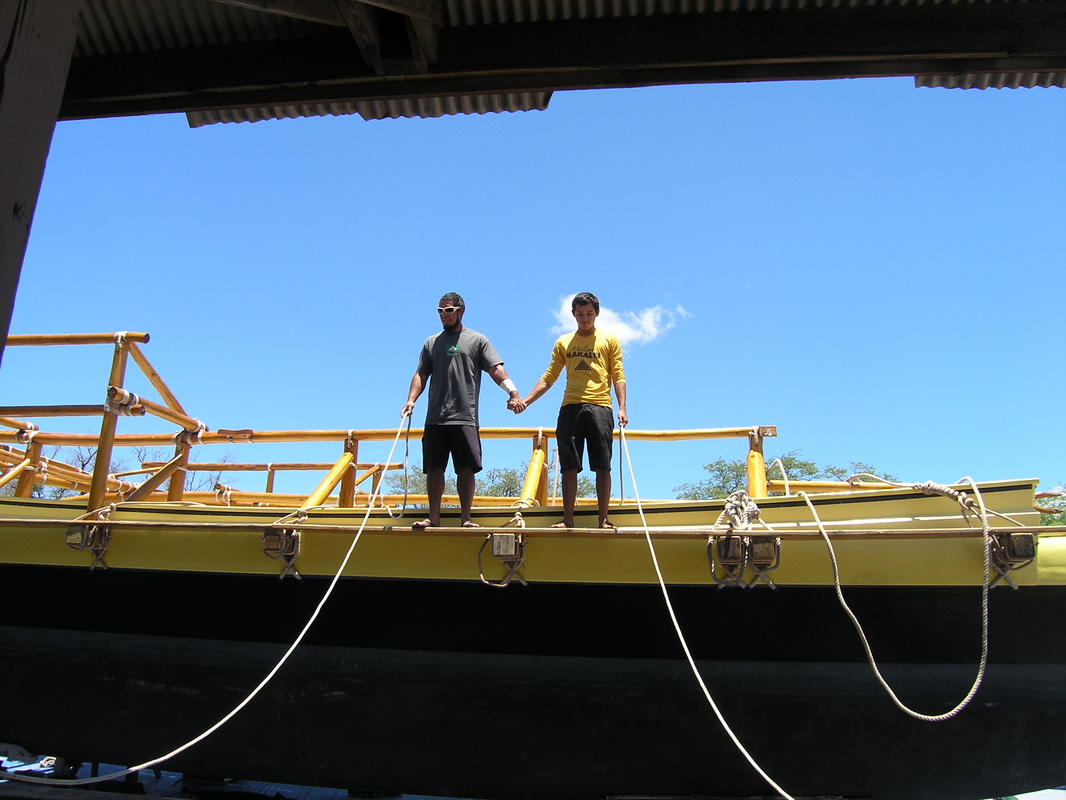
The final section of the day was spent on the pragmatic endeavors of a test sail for returnees and line handling and knots for newcomers. But story is vital to every aspect of the “way of the canoe” and this is no exception. Pua Lincoln Maielua shares the legend of Kana, who is the smallest and weakest of Chiefess Hina’s twelve children. His grandmother Uli sees great potential in him and predicts that he will one day be the only one capable of rescuing his mother. Uli brings him to her upland home, where he grows into a great being with the special ability to stretch himself to a great length. And as his grandmother predicted, he ultimately uses his power to rescue his mother. A metaphor for the importance of line and knots in the voyaging tradition, the legends of Kana also illustrate that even the youngest, weakest member of the crew has the potential to do great things and that if you have the belief of just one person, you can accomplish great things.
Like story, chant is always present and line handling is no exception. Participants are getting a taste of expected skills to come and many are anxious as line coiling practice begins. Crouched and rocking back and forth, mimicking the motion on deck, the rhythm of the chant Iā Moku Kele Kahiki springs to mind to calm and guide the hand.
RSS Feed