Big Island Talk Story by Jan Wizinowich
  • Home
  • About Author
  • Oral History Resources
    • Oral History with Video
    • Oral Histories with Text
    • Resources
  • Oral History with Audio
  • Talk Stories
    • Hamakua
    • Honoka'a
    • Kawaihae
    • Kiho'alu
    • Kona
    • Music
    • Paniolo
    • Puna
    • Travels
    • Wa'a
    • Waimea

Nānā I Nā Kūpuna

5/16/2012

1 Comment


Nānā I Nā Kūpuna

By Jan Wizinowich

    Trust in the knowledge and wisdom of the ancestors, which is what made it possible for Papa Mau to guide Hōkūle`a to Tahiti through unknown waters. Spiritual wisdom is available to us if we are open to the signs. This was the case for Gail Loofbourrow,  a labor and delivery nurse, who experienced the power of aumakua during a difficult birth:
Many years ago, in my role as a labor and delivery nurse, I cared for a Hawaiian woman who was preparing for the birth of her first child. Things were not going as anticipated; as time passed it became apparent serious interventions might be necessary. During this time the many local family members prayed and requested the powers of their aumakua, the owl. I must admit I lacked a full understanding of the aumakua. Prayers were answered; the precious baby came into this side of his world full of vigor and a healthy cry. I thought no more about the aumakua until my ride home. For there on my way through Pu`uanahulu sitting above the highway was an owl staring at me with intensity...There is no doubt in my mind the owl was acknowledging my role in the birth and providing me with proof there was much I needed to learn about the culture of Hawaii. Even if I do not understand a word or belief at the moment I need to respect what I hear and know that it is true.
    We did not arrive to this moment alone, through our own efforts, but through the grace of those who traveled before us. When the Polynesian voyaging canoes embarked on their journey of circumnavigation, they were really  traveling backwards at the same time as they are moving forward--back across the centuries when voyagers found their way here, but also forward to show the path of survival and human sustainability. They are an example of what can be accomplished by returning to and living the traditional values of Aloha: 

A: Ahonui---Patience, perseverance

L: Lokahi---Harmony, agreement

O: ʽOhana---Working together for a common goal. 

H:  Haʽahaʽa---Humility

A: Akahai---Grace, gentleness

    The Makaliʽi, this island’s voyaging canoe, was built because a core group of people, led by Clay Bertelmann and the Bertelmann ʽOhana, persevered with quiet patience.  With ego on hold, a hana nui attitude and an atmosphere of harmony focused on a common goal the Makaliʽi was born.  Even in the face of their amazing accomplishment, the extended canoe ʽohana maintains an attitude of humility and grace.  Aloha continues to work miracles every Saturday as many hands work together to ready Makaliʽi for her next big voyage, with every volunteer, no matter how humble their contribution, being acknowledged with appreciation.  
    It has been suggested that the impetus for the original voyaging canoe was an insufficiency of resources and that the island worked together to create a vessel that would journey to find a place for the people to thrive and grow.  No one knows how many attempted voyages there were, but Hawai'i was born.
    The first Polynesians here made use of the abundant resources to flourish and maintain a life that was grounded in sustainability practices, while at the same time European culture was making its way from the East.  Unlike the finite world of island living, the vast North American continent with seemingly vast resources did not require conservation practices.  These two worlds met in Hawai'i and now we are seeing the results of a mindset of endless resources to be exploited. 
    The sustainable practices of the first Hawaiians are being slowly reclaimed as we prepare to face water and food shortages that threaten our survival. “He waʽa he moku,  he moku he waʽa,” (The canoe is an island and the island is the canoe) are words at the core of master navigator, Clay Bertelmann.  The voyaging canoes are a practical lesson in sustainability.
    But what about our daily lives? What do sustainable island practices look like and what are the lessons of the old wisdom that sustained island populations? Like Gail Loofbourrow, are we seeing and acknowledging the signs of wisdom that are there? 
1 Comment

Aloha ʽAina Kaloko-Honokohau

5/16/2012

0 Comments


Aloha ʽAina Kaloko-Honokohau

By Jan Wizinowich
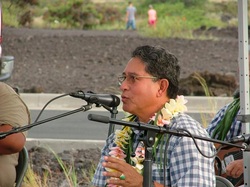
PictureDanny Akaka
Recently there has been some huhu over the use of coral to spell out messages and names, that came up at a "talk story" session with Kahu Danny Akaka. Nā kūpuna whose birth sands are in the area felt uncomfortable with malahini rearranging the landscape.
    The messages celebrate life passages, new beginnings and sad endings, mostly from people whose home is elsewhere and so they do not know the stories of this ʽaina. When visitors look at the lava fields, they see billboard space to advertise their lives. 
    When ancient Hawaiians traveled the King’s Highway, they left their stories in petroglyphs along the way and so the Hawaiians too had the same urge to record their stories, but their stories were part of the ʽaina and derived from the ʽaina; they were not superimposed on 'aina where they have no roots by transporting materials from one habitat to another. 
    While attending the Gabby Pahinui annual slack key festival on Oʽahu, I noticed a t-shirt that read: “Don’t mistake Aloha for weakness”. I think that somehow the Aloha life philosophy gets disregarded and shoved out of the way by well-intentioned people who love this place in the only way they know how. Although I have lived here for many years, I am continually learning lessons of Aloha such as inclusion, tolerance and love for the land. So in deference to Aloha, tolerance for those who feel the need to create coral messages is called for, however, Aloha works two ways; visitors need to hear the voices of the kamaʽaina, the people of this land so they can respect this beautiful culture, this beautiful place and enrich their lives with Aloha.  

0 Comments

Kā Makahiki Hou!

5/16/2012

0 Comments


Kā Makahiki Hou!

By Jan Wizinowich

    It’s 7 a.m. on a clear, cold Saturday morning at Waimea Park, where the 6th annual Kā Makahiki will soon begin.  Pomai Bertelmann and Chad Paishon are making final preparations. These two are a constant quiet, yet strong force, waʽa crew and educators that possess multifaceted abilities, grounded in Aloha, that are focused on perpetuating Hawaiian cultural practices that support the health and well-being of the keiki. Pomai tells me that, although this is the 6th year for Kā Waimea Makahiki, 3 years previous to the 2006 celebration, Kā Makahiki participants from Hawaii traveled to Molokaʽi.
    Kā Makahiki had been a tradition in the islands for centuries and was revived about 30 years ago with the renaissance of Hawaiian Cultural practices. Lono, the God of the Makahiki festival, has a kuleana that includes clouds, winds, rain, sea, growth and fertility.  In 1982, as part of the effort to reclaim and heal Kahoʽolawe, a sacred island dedicated to Kanaloa, through the Protect Kahoʽolawe Fund ʽOhana and with the guidance of the Kanakaʽole ʽOhana, what was probably the first public Makahiki ceremony since 1818 was conducted on Kaho'olawe. 
​    Kā Makahiki, which begins with the appearance of Makaliʽi (Pleiades) rising at sunset, beginning a period of time called Ikua, which by western calendars is the end of October and the beginning of November.  Marking the new year, Makahiki was a time of instructive ritual, harvest, peace and games that tested physical and mental strength.  It’s all about growth and connection and Kā Waimea Makahiki  had that in abundance.
    The crowds on the field representing Hāmākua, Puna, Ka’u and Kohala are a testament to the efforts of  many dedicated kumu and haumāna over the years.  Groups of keiki are schooling around the field in preparation for the opening protocol.  Chad Paishon, sporting a white tuk, and looking like a white capped wave, all strength and calm, moving smoothly through the gathering participants, microphone in hand, calls out to “E ho’omakaukau” (get ready) and directs the districts to their places along the border of the field. The protocol calls for bare feet, which on this morning means much shivering, but the keiki are ikaika (strong).
    The kahu calls, “Hele mai, hele mai, hele mai” and the first group comes to the line to stand and deliver.  Their voices call out in chant and they are answered by the hosts, who are now lined up on the Hāmākua end of the field.  Bowed, eyes on the ground, tributes held at forehead, representatives from the group pass their tributes to the attendants and walk backwards with eyes still downcast.  Hāmākua is represented by a group led by Lanakila Manguil; Kamehameha School, led by Rod Floro, represents Puna;  Kohala is represented by Kumu Pua Case’s halau, HPA, is led by Kūwala Anakalea and even the Zumbalinas, almost making it an A to Z spectrum.  I happen to be standing with Aha Punanaleo ‘o Waimea Hawaiian Language immersion preschool, as I am a sometimes volunteer and was touched to my core as these small keiki with kaleo nui chanted their piko. It touched everyone’s heart.
    The last group was Kanu o Ka ‘Aina.  They looked like a massive mountain gliding to center field with the oldest in the middle, cascading down to the youngest on either side.  Their haka rang through the crisp air as the sun was rising, shooting rays of hope to the grateful gathering.  When they were finished, as if cleaved by one of Pele’s eruptions, the mountain parted to join the circle and completing a lei nui with myriad kinds of blossoms, strung and held there by the positive power of ancient Hawaiian wisdom.  E ho mai!
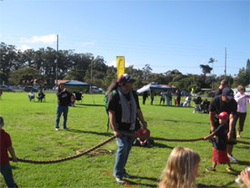
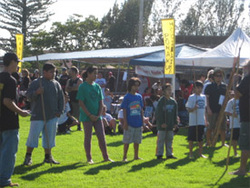
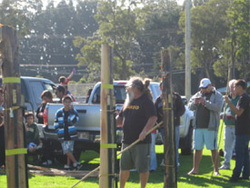
    After a short break, the games began.  There were game stations bordering the field that were identified with bright yellow banners.  Here are a few of the games:
Picture
Hukihuki or team tug-o-war. Pomai Bertelmann is getting the preschoolers ready to Geev Um!

Picture
ʽŌʽŌ Ihe: Young warriors receive instructions for…

Picture
...sending a spear into a banana trunk. Points depend on the height that the spear pierces.

Picture
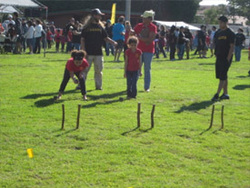
ʽUlu maika: The idea is to roll a stone through two sets of stakes. Accuracy and distance is what it takes.

Picture
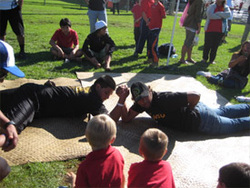
Uma or prone arm wrestling is being demonstrated for the next group of contestants.

Picture
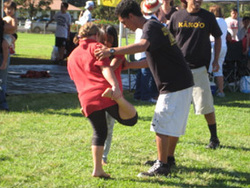
Haka Moa (chicken fighting) involves holding your foot with the same hand and clasping your other hand with your opponent and pushing them off balance.

Picture
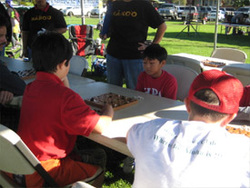
Players match wits with konane, Hawaiʽiʽs version of checkers.

0 Comments

Treasures in Our Backyard - Blossoming in the Moment

5/16/2012

0 Comments


Treasures in Our Backyard - Blossoming in the Moment

By Jan Wizinowich
The wisdom and beauty of Hawaiian Culture lives on in quiet acts of Aloha and through the daily endeavors of many people in Hawai`i Island communities.  In Waimea,  Kuʽulei Keakealani and Pua Case are two people who have worked tirelessly to facilitate a sharing of the many quiet endeavors that contribute to what makes life here special. Their latest project is a four part series of “talk story” sessions entitled “Treasures in Our Backyard”, which is taking place through the generosity of ʽIke Hawaii and four families who have lived the Hawaiian life style and made special contributions to the Waimea web of culture. The first of a series of these “talk story” gatherings took place at the Berdon ʽOhana farm. ​
    If you’ve lived here long enough to see a parade or a high school graduation will have noticed the gorgeous lei gracing our graduates, the vibrant hat lei of the Paniolo, and the exquisite haku lei of the paʽu riders as well as the abundant flowers that grace almost all events.  This beauty encourages us to be present in the moment and to connect with the deep wisdom of the natural world; this is central to the Hawaiian way of life.  The Berdons are a family who, through multiple generations, have made this the center of their lives.  
PictureKuʽulei, Aunty Tootsee
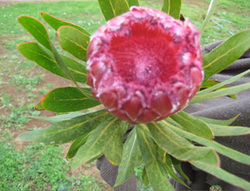
    The weather is surprisingly dry and sunny when we arrive at the Berdon Mānā Road farm, a sprawling verdant 30 acres dotted with many treasures.  We gather on the grass and Kuʽulei introduces Aunty Tootsie. “This is a dear, dear aunty to me although, not a blood relation, still it really doesn’t matter. I grew up watching her dance hula. Her niece is my best friend so our families just connected.  Our prom pictures, when we were getting ready for prom was at grandma’s house.  In grandma’s yard by the protea is where we posed in our gowns and then off we went to our senior prom. What we wanted to capture was families, our treasures that are right in our own back yard, Hawaiians who partake, who live in a particular custom or tradition.  For Aunty it is flowers, lei.”
    As we walk among the unique collection of protea, Aunty gives us a little history. “That’s another facet of my Hawaiian family.  My mom, Bernice was born in Waipio Valley;  her parents were 100% Hawaiian taro farmers and then they came here to be vegetable farmers.”  Bernice and her husband Alfred took over the farm 57 years ago when Tootsie’s grandfather left to be a kahu.  While they primarily grew vegetables, Tutu Bernice soon began growing and selling flowers and lei.  “Mom opened the first flower shop in Waimea. It was there by Sure Save, Ben Franklin, called Bernice's Flowers.” 

Picture
    The flower shop was sold when Tootsie was still in high school, but 32 years ago she decided that she wanted to be in the flower and lei business.  “Back in the day it was really different.  Tropicals were not so big.  Lots of carnation.  Mom grew many of her own flowers.”  Growing what you need is a philosophy that is in evidence.  “The more you raise, the less you need to purchase. Everywhere on the farm you’ll see lehua of every color and we raise our own foliage.  Just trying to stay alive in this economy.”
     The knowledge of growing and lei craft, Tootsie got from her parents, “My mom and my dad are the farmers and the teachers.  I also learned many, many things from Marie McDonald (“Ka Lei”), my neighbor. She is such a loving, giving person.” The lei tradition was passed to Tūtū Bernice from her father, “My mom learned to make an akulikuli lei because papa just made them do it to wear on his hat.  Just to wear around town.” Now, Tootsie’s parents live right down the road and Tutu Bernice, who is 80, may have a slipping memory but she has certainly not forgotten how to make lei.
    The Berdons are living more of a lifestyle than running a business.  Everyone has kuleana and much of the day revolves around that. “I come out and pick every day.  We’re just done with the holiday season and everything is kind of picked out.  Now it’s time for manicuring.” There are a couple of stunning protea called Regina and Andrea that were obtained through bartering with Australia by the Protea Association. “I don’t think any other farm has this. Also we have monstera, succulents; we have a little bank of succulents. My husband’s the one who comes out in the afternoon and plants all kind of fun stuff.” 

PictureDeedee (Jill)
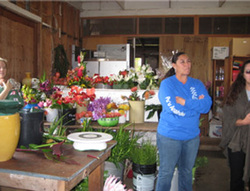
    Our next stop is the central hub, a large shed that contains the office and the packing operation.  Behind the counter we find Jill (Deedee) and her friend Kelsey.  “Hello girls.  This is Kelsey and Jill.  Jill is my daughter and this is where it all happens.”
    Behind them on the wall is an enormous white board, covered with work orders.  Deedee gives her manaʽo about the work they do and how she got involved, “I went to Florida, to the University of Miami and that’s where I had my daughter.  I had a guy ask me if we wanted to sell flowers.  I talked to my friend and asked her, ‘Do you really want to sell flowers over here in Miami because we can do that at home’.  I came back, but I didn’t do it right away.  I was teaching at Waiʽanae and that was really difficult.” 
    So Deedee (Jill) and Kelsey came to Waimea.  “I told her, ‘Just come home, give it a year and if you don’t like it you can leave.’  Well she’s been here three and a half years so I guess she’s here for good.”
​    Deedee has a deep appreciation for her ʽohana and the ʽaina.  “I’ve gone all over the world and I’ve never seen an akulikuli lei.  It’s something my grandma does as a hobby. A kind of ‘I just do this to pass the time activity’ and it’s really an art and she doesn’t know how special it is.  My Mom’s been doing it for 35 years and she doesn’t know how special it is.  And so I just decided that it was time that somebody that knew how special it was would come here and make it special for everybody, to remember that this is where we came from and years of family history that I didn’t see going to waste. Make beautiful things with beautiful resources.  That’s the Hawaiian way. It’s all just to say aloha.” 

PictureTootsie
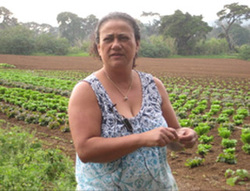
    We journey on to find more treasures.  Kahili ginger is growing along the trail and a heifer and calf munch peacefully.  Coming through an opening in a row of trees, we stand before a huge, neat field with pristine rows of lettuce. “This is my brother’s. He just grows three kinds of lettuce and radish. Enough for him to survive and he’s good at it.  The land is so big so he rotates and he doesn’t have to spray.  No pesticides.”  Bordering the vegetables are the akulikuli beds.  “The girls and I have just started to get into it since Xmas is over, these two patches.  We normally plant a little section just this big every year and that’s all we really need.”
     Pua shares her manaʽo about what we are seeing here and how it connects with our daily lives.  “Waimea, if you’ve been here all your life, for those of us growing up here 50 years ago and even before that, everybody at an event had a lei on.  Every paniolo, every cowboy.  You no go rodeo without flowers on your hat, a hat lei with fresh flowers. In today’s lifestyle we don’t have time or our kids don’t know how, which is part of why we are doing this. Today’s Waimea is extremely different in the flower, in the lei.  Very few Hawaiians especially in Waimea that at every event has a lei on.  The exception to that is Aunty Maile Napoleon who lives by the park.  No matter what event, she will have a lei on and everyone in her entourage will have made a lei and have a lei on. If she knows you’re going to be someplace.  Like the opening of the film festival she couldn’t stay but she came to the opening just to put a lei around my neck.  She just honored what we were doing. And one of the oldest lei that our people have worn is the akulikuli and this is where it all begins.”  

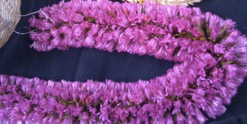
PictureAkulikuli lei
    Living from the land is an important aspect of aloha, but the Hawaiians also celebrated life by creating beauty from the incredible resources that surrounded them.  This is a tradition that has been carried on by the Berdon ʽOhana, but is also slowly being lost.  “Back in the day, everybody had akulikuli.  You could go to the airport and pick.  Around the health center, all over Waimea.  We really need people to plant and make use.  That’s the only way we’re going to get people to wear more lei.”
    The idea of creating and protecting island resources is vital to maintaining our aloha lifestyle.  Kuʽulei who lives this lifestyle every day, shares that, “Perhaps you might see me, my kids, my dad, my sister in a parade and we’re wearing these lei. Hands down, every parade we going to be there and we’re going to need lei.  Quite honestly, we don’t make them.  It’s a phone call to Aunty Toots or we going to our other resources who we know are the lei people.  The Bertelmann ʽOhana. Those are the people that put our lei together for our horses, for our bodies to be adorned with them.  Perhaps in our little yards we can start growing the things we need.  And that is how it should be.  Not just utilizing the resource and then what?”

Picture
    The Berdon ʽOhana also has ocean roots. Have you ever seen any Aliʽikai boats cruising around, hauling in fish? Well here’s the story of their origin:
    Aunty Tootsie’s dad, Alfred was born in Kawaihae, where his dad was a fisherman. “In the 1930’s he owned 7 sampan fishing boats.  The men would go out in the morning and hook aku and all of that and come in and my papa would distribute all around the island. Back then the roads was crazy and it took him the whole week to deliver all that fish.”       When Papa died young, making it necessary to sell the business, a seed was planted. “My dad grew up a fisherman and it was always deep down inside he wanted to eventually build a fishing boat for Hawaiian waters.  He would sit at night drawing his dream boat.” And eventually that dream was realized. “My brother took over the vegetable farm and we traveled to Seattle and we went and visited boat shops and he found out how to do it all.  He came home and built the mold and Dad built Aliʽikai boats for many years.” 
    The first chapter in these “talk story” sessions closes and Pua reflects about the “treasures in our backyards” that are the webs of culture that really define this place. “Every family in Hawaiian Homes that dates back has a story like that.  And when you get to know people or you just pass by and ‘I know that’s the Berdons and I know where to get a lei if I need one’, or you see them at the Saturday market and you have a relationship.  That’s what it’s all about is relationships.”  
    There is so much old knowledge that has been lost and we don’t’ even know we’ve lost it.  There is a legacy of knowledge and wisdom  before our very eyes that we can’t see or appreciate. “Right here in this village are people that are every day doing unbelievable things and we don’t even know about it. The root and the core and the foundation of Waimea are the Hawaiians who live here.  Even their own children and grandchildren don’t know.  Everybody doesn’t still cook in the imu, everybody doesn’t raise their own food, everybody doesn’t play music in the garage at night. For us, this is a treasure.” 

0 Comments

Hana Hou Cowboys

5/16/2012

0 Comments


Hana Hou Cowboys

By Jan Wizinowich
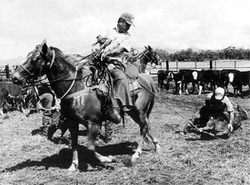
Picture
Photo by: Margie Sims
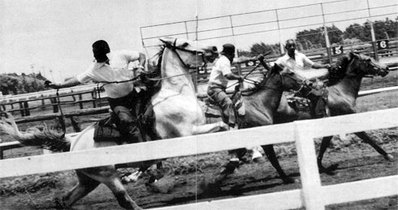
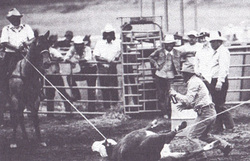
    It is probably safe to say that the most unique attribute of Waimea is its location within one of the world’s largest ranches.  Where else can you see top-notch working cowboys strut their racing, riding, roping stuff?  One of the events to be celebrated by Parker Ranch in this one hundred fiftieth anniversary year, is the thirty-sixth annual Fourth of July meet.  Over the years, it has been a showcase for the riding skills of local paniolo as well as an opportunity to honor visiting dignitaries and retiring employees.  In reading past accounts of the rodeo in the “Paka Paniolo”, one senses that this celebration was one of closure for the events of the year, a reflection on the past year.
    The meet begins with an opening ceremony in which both retired and current paniolo, on well-groomed Parker Ranch horses — flags and banners waving — ride past the reviewing stand for the raising of the flag and the national anthem.  Traditionally, the flag raising has been accompanied by various bands from the Big Island and O’ahu.  Following this, Richard Smart would announce the year’s honorees and then pronounce, “let the games begin”, which consisted of a series of races (relays, 1/4 mile grade, 3/8 and ¾ mile thoroughbred), reining, wild cow milking and roping.
    In 1963, a large banner proclaimed “Keiki O Ka Aina”, designating the meet as Frances I’i Brown Day.  “It was one of the largest turnouts in years.  Weather was good, the track fast and beaming through it all was Frances I’i Brown, whose day it was.” That year the Boy Scouts handled the flag raising, Kent Bowman manned the mike and Morgan Brown judged the events.  Yutaka Kimura came in first on the quarter-mile race, riding Thunderbird; Masa Kawamoto, riding Miracle, made first in reining and calf roping; and Joe Hui won the barrel racing riding Lucky Legs.
Picture
    Although the year’s meet began with a snafu that prevented Schofield Barracks’ Second Brigade, Twenty-fifth Division band from arriving on time, this did not affect Masa Kawamoto’s stellar performance.  Teaming up with Miracle, Masa took the Linfoot trophies for best horseman and best horse.  The prized silver bowls were his for keeps, as he had won three years running.  Also honored that year was Willie Kaniho Sr., a sixty-nine year old veteran of the ranch.  John Wayne, in the islands filming “In Harm’s Way”, was on hand to sign autographs. 
    Cold, misty Waimea weather set the scene for the 1966 celebration, which honored Neal S. Blaisdell, then mayor of Honolulu.  The flag raising was serenaded by the Konawaena High School Band who were, “nattily outfitted in their green and white uniforms…[and] opened the day’s festivities with a snappy march.” However, the four legged participants had their own agenda. “Perhaps the weather was a little unsettling for the horses, or maybe they were a little bored because….some of the horses chose not to compete in the races but to put on a wild west bucking exhibition.”
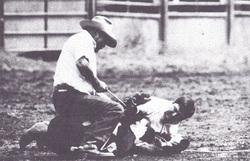
    Two special events took place in 1966.  There was a calf tying for budding young paniolo eleven to fifteen years.  The first and second place winners were Valerie and Joel Hui (children of cowboy Joe Hui and Aletha Lindsey). Also that year, was an old-timers roping exhibition with Willie Kaniho, 71; Yutaka Kimura, 61; Joe Pacheco, 62; Frank Vierra, 60 and Henry Ah Sam Sr., 68, who all learned their roping skills many years ago on the wide open range lands of Parker Ranch.  A new award, the Parker Ranch riding stable perpetual trophy, was added for the trainer of the winning thoroughbred. 
    The following year’s celebration belonged to Yutaka Kimura, who retired in 1967 after forty years of service.  “As the paniolo paraded past the reviewing stand, they were led by flag bearers Joe Pacheco, Billy Boy Lindsey, Charley Stevens and Walter Stevens.  Leading the riders was Yutaka Kimura, honoree, on his favorite palomino.  He paused at the finish line and watched his buddies file by, then galloped out of the track and up to the reviewing stand…”  With the graceful style that is his signature, Yutaka bid aloha saying, “Although I am leaving, my heart will always remain with Parker Ranch.”
    In 1968, the celebration was an emotional one that was filled with losses.  The tragic death of John Hu, “who was killed as a result of an accident early one morning in the Pu’uhue corral when his horse suddenly and without warning leaped up into the air falling backward on John…” was commemorated by the presentation of a flag to the Paka Paniolo Horsemen’s Association from John’s family.  A moment of silence was also observed in memory of Billy Boy Lindsey and Pedro Delos Santos, who had recently passed away. 

Picture
    Highlights of the races saw Jiro Yamaguchi come in a winner in team ropping with Masa Kawamoto. Jiro and Molly Yamaguchi’s son Mark, won the Shetland pony race. Riding Cherokee Rose, Louis Akana captured best horseman, breaking Masa Kawamoto’s six year winning streak. The events of the Fourth of July Rodeo and its skilled participants are one of the many things that make Waimea so unique. 
    The rodeo carries on through decendents of  Parker Ranch Paniolos and reminds us each year of the legacy of skill and toughness exemplified by such greats as Ikua Purdy, who won the 1908 Cheyenne Frontier Days Rodeo.

0 Comments

Connecting to the 'Aina with Aloha

5/15/2012

0 Comments


Connecting to the 'Aina with Aloha

By Jan Wizinowich
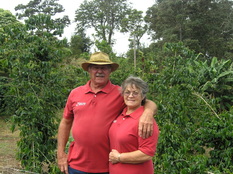
PictureWendell and Netta Branco
    To Wendell and Netta Branco, aloha and ‘aina always go together.  Raised in a plantation lifestyle, they have never lost their connection and appreciation for the land and its bounty.  Longears Coffee, their current endeavor, grew out of that connection with a little added serendipity and perseverance. 
    The very best serendipity in their lives was meeting each other in Waimea.  Netta’s independent streak landed her in Waimea from Lahaina.  “There was so much family in Lahaina and I wanted to spread my wings.  I worked in a supermarket, Black’s supermarket. You know where Ace Hardware is? Right by Ace Hardware.  Well that’s where I worked as a cashier and Wendell worked right next door at the service station.”

    You’ve heard of catalytic converters?  Well Netta’s radiator was a catalytic match maker. “Every time I’d go somewhere, I had to go to the service station and fill up the radiator and that’s where I met Wendell.  I said, ‘Would you like to go to lunch?’ He left the service station for us to have lunch for 3 hours. That’s where our love life started.” Wendell adds, “And we’ve been having lunch ever since.” That was the beginning of a long journey filled with aloha. But before that Wendell and Netta had very different beginnings.   
    Born in Honoka’a in 1942 at Okada Hospital (now serving as a medical clinic), Wendell grew up in Honoka’a.  World War II interceded and swept his father, David Ishisaki, away to an internment camp on the mainland, before he was born. “Taken away from home.  You gone.  Bam.  He was one of them, he got hauled off.”  Wendell’s life journey took him as far off as Alaska and full circle back to Hāmākua and Waimea where he eventually met and married Netta. 
    Netta was born in 1942 on O`ahu and lived in Palolo Valley until her family moved to Maui. “My father used to drive the rapid transit truck or bus on O`ahu.  Also he was Samoan, from Pago Pago and he had a Samoan Band. When the war broke out it was very hard standing in line with two children, so my grandfather gave them tickets and they came to Maui.  We lived in Lāhainā, Maui for all those years.” Netta led an idyllic life surrounded by family, with the ocean just steps away.  “The most fun we would have would be labor day.  We’d go out.  David Sharp he had a big barge.  That was what all of us kids loved. We’d go in small skiffs to the barge. And they would bring all the picnic tables, all the coolers and we’d have all kinds of fun and we would dive and jump from the barge.  The ocean is greenish blue;  it was out Napili side, way out there.  Everybody would bring food and tons of watermelons and us kids would just look forward to it.”   
    Wanting a life connected with the `āina Netta and Wendell found and purchased land in `Āhualoa.  After selling their house, with an agreement to live in it until a house was built in `Āhualoa and having that agreement fall through, they moved to their land a little sooner than they expected. Wendell said, “Pack up your things.  I’ve bought myself enough lumber to build a garage.  We’ll live in that garage until we build it ourselves. You got 12 hours up and 12 hours down.  That’s about how the day goes.  And we were, all of us in that one room.  I’d say that room was 30 by 30. It was like, you know living in the yellow submarine.” But not for long. “Every time we scraped up some money, we’d build a room.  Now we have three bedrooms and a big house.”  
    They moved to `Āhualoa with three boys ages 3,5 and 7.   No electricity, no running water but no matter, they were living aloha ‘aina.  At this time, Wendell was working as the first paid fireman in Waimea. “It was just me and that old Studebaker fire truck.”  This meant that he would go off for two days at a time.  “They were babies.  Everything, everything we own into one big shed. Toilet on the outside.  No electricity.  No running water. Take a bath.  Japanese furo.  Until this day we still have the furo.  Kerosene lanterns, wood stove.  Then I was working at the firehouse.  So I’d be gone every other day.  This poor girl is up here in the middle of nowhere.  No electricity.  No water that reached the house.  The water stopped outside the house.  So the least I can do for this girl is get her a phone. The least I can do.  She needs to get a phone,” Wendell reminisced.   
    At that time the old Māmalahoa highway was a dirt track and the only way to reach their land was by using a 4 wheel drive.  “The second vehicle was not 4 wheel drive.  Big old clunky Chevrolet Impala. One of those, it looked like a big old tank.  So she’d take the littlest guy, which was the baby.  She’d take him with her down shopping.  I’d stay up here carving this place out of the woods with the other 2 little guys and she’d do her shopping for the day and for the next day.  Cause the next day I’d go to work.  So she could go down, but she’d never come back up.  So she go shopping, she’d come.  We had the signal.  She honked the horn, whatever the signal was.   I’d go down with the chain and bring her home,” said Wendell.  “We loved it. We loved it. We loved it,” interjected Netta.  
    This strategy came in handy for phone installation. “There was no road.  There was ginger patch, brambles.  There was nothing here. So anyway I called the telephone company and they sent a man out.  He couldn’t get up the road with his van, so I asked him, ‘If I can get you up here, can you put the phone in?’  And he said yeah, he could do that.  So I hooked the tow cable onto his van and up he came. There’s not too many things we couldn’t do.” 
    Their family values have to do with work and nobody got a free pass.  Their lifestyle made it easy to pass on those values. “I used to have a string of cows that I milked for about 12 years. Me and Wendell and my sons, that’s how we trained them to start working.  So I would milk in the morning and in the evening.  And Wendell, when we had electricity, would put a refrigerator out to barter with people, neighbors.  Whatever they want, if they want to take a gallon of milk, they leave something, eggs or whatever.  And I had a little jar there and if they didn’t have anything they’d put cold cash. Whatever it was worth to them.  So that’s how we’d do.  That’s how we trained our children to work and they hated it because early in the morning,” Netta shared.

“Before they go to school they got to get those cows in that wet grass,” said Wendell.  

    “I would train the cows how to come in the morning. I would shake the ti leaf and as soon as they hear that they would start running down and it was easy,” continues Netta.  And very soon, their sons caught on how to do it.  Watch and learn.  

    Wendell’s job at the fire station lead to the solution of the mystery of his missing ‘ohana.  “My wife and I had a family. It was in the back of my mind.  I wanted to know the scoop. My family tree.  One half of the tree didn’t even have one twig.” Once again serendipity came into play.
    “Waimea had a volunteer fire station at the time.  It was Parker Ranch cowboys.  Then I got upgraded and they sent another fireman up there.  He came from Honolulu.  And one day over a bowl of saimin, I found out that he was my cousin.
     I says, ‘Yeah, you know I got some kind of Japanese heritage.  I can’t prove anything.  All I know is that my father’s name was David Ishisaki.’  
​    And he looked at me and he said, ‘David Ishisaki is my mother’s brother.’ And we got to talking and he says,  ‘You know what, I’m going to Hilo tomorrow and talk to David’s mom,’ which would be his grandmother, ‘And find out just what’s happening here.’  
    I said, ‘But my dad’s dead.’
    "And he said, ‘Oh no.  Your dad’s alive and he’s living in Lanakila housing in Hilo.’ And all these years.  It goes beyond the fluke.”
     Wendell solved a mystery and got to connect with a whole family he never knew he had. “We go to Hilo.  Never saw the man for 32 years.  He was bedridden.  My auntie, which I now met.  She would go into Hilo and prepare a bath.  She falls and injures her shoulder and she can’t perform this duty for her brother.  So we go in.  I never met the man.  We become friends and I’m helping him with his bath.  But I believe the camp, the concentration camp or whatever it was, messed up his mind bad. He lives 6 months and he died.”
    Wendell’s next endeavor after the fire station, was to raise mules.  “I grew up around animals.  Cattle, horses, pigs everything.  So I always like to go into faraway places like the mountains, the valleys.  I always liked to go into Waipi`o, Waimanu and beyond.  So I told myself, you know what, I’ve always heard about mules.  How great mules were and how nasty mules were and I figured, I’m going to figure this out for myself, if any of this is true.”
     After researching locally he found that the only mules available were elderly retired plantation mules. Undaunted,  he started looking on the mainland and once again Wendell’s resourcefulness paid off  when he located and purchased his prize jack named Ozark and one mule.
    “Those days they had stock flights, airplanes that came into Hilo. So my first mule and my big old donkey Ozark, my favorite guy, came from Missouri. And he came from Oakland California to Hilo Hawaii on a 747 jet.  Flew right in.  So that’s how my mule breeding program began.”  As always, Wendell and Netta chose the path not taken and forged on to make another of their endeavors work.  “All of my cowboy friends they’re all horse people and when I started into this mule venture, they figured I’d really lost it.”  
    But registered mules were in demand.  “I would buy old retired Parker Ranch horses, cowboy horses.  Because they were registered horses. Basically quarter horses. And then Ozark, that’s the name of my jack. His entire handle is a: Catalonian  Mammoth Registered Goldstar Dappled Red Roan jackass. And he was the only Goldstar registered jackass ever in Hawai`i . And the registered mares, I would breed mules off them.”  
    Wendell’s mules made it possible for him to go to places on the island where few people travel.  “I always like to go into faraway places like the mountains, the valleys.  I always liked to go into Waipi`o, Waimanu and beyond,”  and his mules never let him or Netta down, who reminisces, “We’d go riding.  I’d go down this gulch and he’d say, ‘Yes’ and I’d say, ‘No way. I’m getting off.’ And he said, ‘No. Just hand on, sit back and he’ll go.’ Next time I opened my eyes and we’re up already. Didn’t feel anything, you know.” 
    One of their biggest adventures though was helping Kindy Sproat build a house 2 valleys in from Pololū.  Kindy wanted to build another cabin to replace the one he was born in and had been taken by the 1946 tsunami.  So Wendell got his contractor friend, Jack involved, who promised that if the materials were there, he could build a house in one weekend.  Wendell brought in his mules and transported airdropped materials into the valley and good as Jack’s word, by the end of the weekend the cabin was built.  That began many happy journeys to Honokanaiki for the Branco family. “So we went in there and built a couple shelves.  We built one bed. Box bed with the mattresses on em. Fixed the toilet house.  Then we’d spend the weekend. We all loved it.”  
    When their jack Ozark died ten years ago,Wendell and Netta looked around and noticed Arabica coffee plants, “…from Hamakua’s coffee glory days fended for themselves on our ranch.”  So after picking 300 pounds of cherries they found out that no one wanted to buy beans from the Hamakua area.  So once again, Wendell and Netta struck out to learn something new and decided to process and roast and sell their own coffee beans.  Quite by accident because they couldn’t sell their coffee beans, they learned about aging coffee, which produces a much smoother, more flavorful coffee.  
    Not having enough coffee cherries on their land, they looked around for other farmers in the area that had coffee trees, which is when they met old time farmers who shared something about the history of coffee in the Hāmākua district.  Brought in by a couple of traveling missionaries, Arabica coffee has been growing in Hāmākua since the early 1800’s and according to Wendell, “To this day, the coffee that exists in these valleys is the same Aribica coffee.”  With the sugar plantations came Western ideas, one of them being coffee.  “There were people who lived up in the hills, homesteaders.  Most of them Japanese.  They started taking the coffee plants and planting them up on their homesteads….the people we buying coffee from now, that’s how their farms began.”
    Now with the coffee company a going concern, their farm is a center of activity.  Netta’s elderly mother, a living treasure with her own quilting story to tell, lives with them and their sons stay in close contact.  While doing this interview one of their sons arrived to bring them some dragon fruit and looks of love and admiration.  Not too different from the looks they have for each other.  After 40 years of marriage and 3 kids they are obviously still in love. Their looks are full of spark, understanding and kindness. Netta and Wendell have created a vortex of Aloha.
0 Comments

Ku Holo Mau**Sail On, Sail Always, Sail Forever

5/15/2012


Ku Holo Mau**Sail On, Sail Always, Sail Forever

By Jan Wizinowich
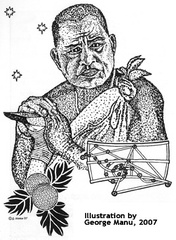
PicturePapa Mau
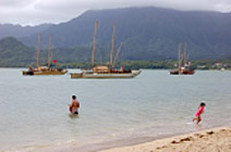
    When the conditions are right and the captains and navigators concur, Maisu, Hokulea and their escort yachts will begin their journey to Papa Mau. It's Monday morning, January 15, following Sunday’s ceremony, a gathering of friends and family to release the canoes.  Mahukona is quiet and peaceful.  The day is clear with light Northeast winds fussing the water beyond the shadow of the island.  On a small grassy knoll, oriented Southwest, is a ring of stones that form a navigational heiau providing guidance to voyagers past and present.  Beyond, whales breach and sound as if in invitation to the voyagers to share their ocean highway.  
    The canoe, Maisu is the latest effort in an odyssey to reestablish traditional ocean voyaging using the art and science of wayfinding practiced by the ancient Polynesians. The inception of the Polynesian Voyaging Society in 1973, began the process of reconnecting with the lost art of wayfinding practiced more than 800 years ago by Polynesian voyagers.  
​    Hokule’a’s first voyage in 1976, navigated by master navigator Mau Piailug, provided the inspiration for the building of canoes throughout Polynesia, the training of successive generations of navigators and many historic voyages.  But none of this would have been possible without Mau’s generous gift of the knowledge of traditional navigation. The ocean voyagers of Hawaii wanted to give something back to Mau and to the younger generations in Micronesia; Maisu was the result.

    According to Maisu’s navigator, Chadd Paishon, “The idea of the canoe was to help him help his people. Every canoe is born for a specific purpose and every voyage has a theme.” The name Maisu derives from a Satawalese word for breadfruit that falls to the ground during a high wind and feeds all the people.  Mau’s mission is to help his people  not be dependent on western contrivances such as motors and gasoline. “Mau thinks it’s crazy that so many people are buying motors when they don’t even have gas,” shared Paishon.
    Planning for Maisu began in 2001 when Mau met with several members of the Hawai'i Voyaging community. Maisu, a Big Island grassroots effort, coordinated by Na Kalai Wa’a Moku O Hawaii (The Canoe Builders of the District of Hawaii) began its life on Oahu, where the friends of Hokule’a and Hawai’iloa constructed the twin hulls. Young Brothers then shipped the hulls without charge, from O’ahu to Kawaihae, in September 2003, where the majority of the work to build the canoe began.  
    This involved a core group of people headed by the late master navigator, Clay and his brother Shorty, as well as Steve Garrett (master boat builder) and scores of volunteers who gave what they could.  “Clay’s daughter Pomai Bertelmann of Nā Kalai Wa’a Moku O Hawai’i pointed out "We had people from New Zealand, Argentina, South Africa, Japan, Hawai’i, California, we had people from all over the world working on this canoe. We couldn’t have asked for more.” (Mālama Hawai'i News)
    Rather than being constructed from blueprints, the design was created based on her purpose and available materials.  Weaving all the factors together, Maisu evolved in what seemed to be a dialogue between the spirit of the canoe and her builders.  
    First they looked at Makali’i to evaluate what worked about the design and what didn’t work. “We also had to look at the waters where Mau lives. The traditional Micronesian canoe has a much sharper hull because they need to sail more to the windward. But Hawaiian sailing canoes have much more rounded hulls because there is much more of a lee drift.” said Paishon. However, because Mau’s plan is to teach as many people as he can while his health permits, he requested a large Hawaiian voyaging canoe to accommodate larger groups. 
    The mast and the sails, however, needed to work for the wind conditions it would encounter in the various Micronesian island groups. “Normal windspeed in Micronesia is 5-10 knots, which means they need to use very large sails and need taller masts to support them.” (Paishon) Recent sea trials in much windier Hawaiian waters have sent Maisu flying, proving the effectiveness of the rigging.
    The electrical system also had to work in Micronesian waters. This was designed and installed by Robert Harbison, who was at the recent launching of Maisu. Pointing out a sealed metal rectangular box about 1’x3’x2’, securely attached to the deck, he explained that it contained the electrical system that will be used to charge and power any onboard electronics such as radios. A self-contained modular system perfect for the Micronesian islands, as it can be shipped back to Hawaii for repairs or replacement parts.
    Maisu is comprised of two 57 foot hulls, the top sections of which are painted yellow and the bottom sections black. Launched on Dec. 16th at Kawaihae Harbor, captained by Shorty Bertelmann,  Maisu will soon begin the first leg of the voyage, crewed by five Micronesians and one Maori and seven Hawaiians. It will take Maisu to Majuro in the Marshal Islands, where there will be a crew rotation. From there Maisu sails to Ponape and Truk, in the Truk Islands, continuing to exchange crew members along the way.  The final destination in the Carolines includes stops on Pulap, Satawal (Mau’s home island), Woleai, Ulithi and Yap.
    Mau returned to Satawal last June, but is in regular contact with Chadd.  Although, due to failing health, Mau has limited time to carry out his mission,  “… every navigator has a backup plan.” His son, Sesario, has decided to carry on Mau’s work and  Mau also feels secure in the knowledge that, “…he has planted the seed in Hawai'i.” The voyage has come full circle.  The breadfruit that came to Hawai'i and fed the travelers who found their way through the mysterious ocean forces will, through Mau’s gift of wayfinding, return to the source.   
**Name given by Pua Kanaka’ole

We Are One: Parker Ranch and Our Changing Waimea Village

5/15/2012

3 Comments


We Are One: Parker Ranch and Our Changing Waimea Village

By Jan Wizinowich
Picture
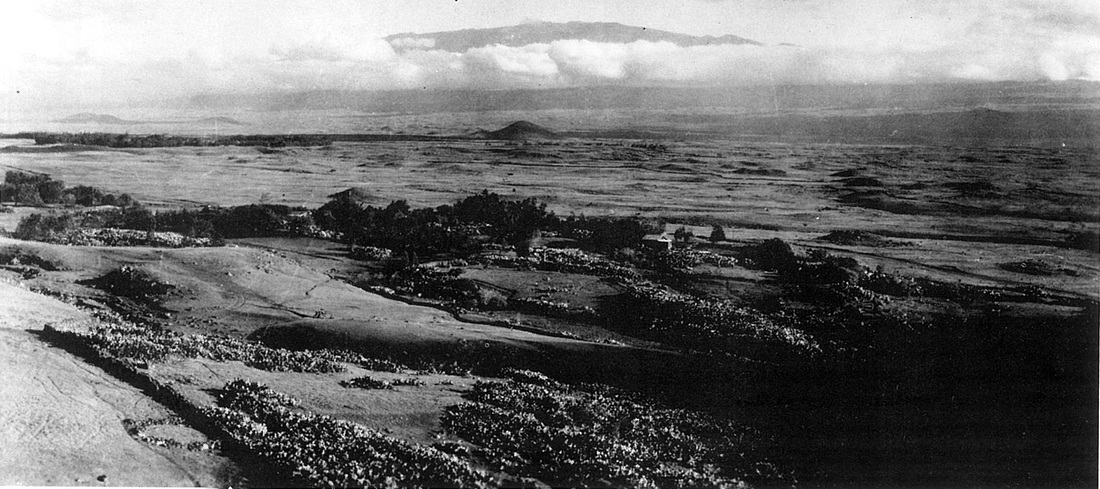
    The One hundred fiftieth anniversary of Parker Ranch can also be considered a commemoration of our Waimea Village.  Just as Hawai'i Island began to work its magic on John Palmer Parker, the endeavor began by him so many decades ago has shaped Waimea into the special place it is today.  The old district, dotted with native villages, has changed in obvious ways from the early, sleepy days.  While the fast pace can be unsettling and we no longer have the pleasure of seeing travelers on horseback traversing mainstreet, the broad, rocky plains, sweeping up to the often snow topped sentinel of Mauna Kea, serves as a constant link to the majesty and history of this place.  The spirit of hard work, aloha ‘aina, and ‘ohana are important legacies that have contributed to Waimea’s unique flavor and to the survival of Parker Ranch.  
    The destinies of Waimea and Parker Ranch were tied together from its inception, blending stiff New England ways with rich, Native Hawaiian Culture. From the beginning Parker embraced the native ways and made them his own. “…he possessed certain personal attributes that instilled respect in all those who made his acquaintance.  His quiet, unassuming but self-assured manner made him popular with the natives” (Wellmon, The Parker Ranch: A History). 
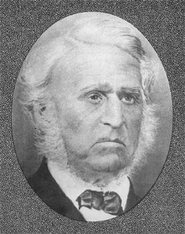
PictureJohn Parker
John Palmer Parker’s New England roots, when transplanted in Waimea, created a hybrid much like the indigenous ‘a’ali’i plant, which has strength and flexibility, yet produces colorful, delicate, lantern-like flowers.  He had a flair for chanting, music and storytelling that lit up the dark Mānā evenings. “He had an ear for the native chants, and he could intone ancient Hawaiian songs with the best storytellers on the islands” (Wellmon).  
    Parker’s openness to new skills and ways combined with hard work contributed greatly to the early survival of Parker Ranch.  Before ranching was really established  on the Waimea plains, Parker, working at French’s store, “…listened to the stories and wisdom of the Mexican vaqueros who had come from California to work the mountain cattle.  Here with natives congregated about a bright fire blazing in a cavity in the earthen floor…Parker listened attentively as gnarled faces, partially covered by large sombreros and obscured by the dimness of the room, broke out in smiles and nodded in unison to tales concerning life on the large cattle ranches in California where they had grown up” (Wellmon).
    On his marriage to Kipikane (granddaugher of King Kamehameha I), Parker was given a small grant of land in Kohala.  But the real beginning of the ranch operation centered on a six acre plot near the foothills of Waimea, granted to him on January 8, 1847 under new legislation that challenged the traditional Hawaiian land tenure system; it was here he built his first home at Mānā. Three years later, Parker was able to purchase the 640 acres surrounding his homesite.  This was augmented by the acquisition of another 1000 acres the following year and the lease of Waikoloa lands from Kamehameha III a year after that. 
    With hard work and frugal ways, mixed with Hawaiian style, Parker Ranch became securely established.  Parker and Kpikane had 3 almost-grown children – Mary, John and Ebenezer and he set about creating a permanent home and farming/ranching operations centered in Mānā.  
    Parker began to gather a retinue of native workers whom he treated as ‘ohana.  This mutually beneficial relationship intertwined the destinies of the ranch and the native residents of Waimea during a transitional time. With the influx of westerners, the challenge of the kapu system by Liholiho and the demise of the old tenant land system the old foundations of life were changing.  Parker needed hands to help him operate his growing concern and the Hawaiians needed work. 
    After Parker died in 1868, having established a prosperous enterprise for his son, John II and grandson Samuel, there were difficult challenges for the ranch.  Drought made food scarce, and Kawaihae harbor was destroyed by storm and a tidal wave. However, John II continued to run the ranch much in the same fashion as his father, while Samuel attended school on O’ahu. 
    The fortunes of the ranch changed with the return of Samuel, who enjoyed the ranching life, but had no interest in working it.  While he brought an air of levity to the somberness of Mānā and made improvements to the houses there, his spendthrift ways and an unwise investment in the newly-established sugar cane industry threatened the survival of Parker Ranch and caused a rift in the family.
    Although the ranch was in disarray, the powerful legacy set in place by John Palmer Parker, remained and seemed to take on a life of its own.  Parker Ranch saw its salvation arrive in the form of A.W. Carter and Mrs. Elizabeth Dowsett “Aunty Tootsie”, who was the wife of John III (Samuel’s eldest).  John III died suddenly and left Aunty Tootsie with one child, a girl named Thelma.  
    Asked by Mrs. Dowsett to protect her share of the ranch, Honolulu Lawyer A.W. Carter took on the responsibility with the kind of zeal possessed by John Palmer Parker.  Carter was a hard-working man who loved the land and believed in an all-inclusive ‘ohana founded on mutual beneficial endeavor.  His willingness to work alongside the cowboy gangs gained the respect of all. “It was common for him to be in the saddle before daylight, riding with the paniolos over rough terrain, working through brush and through heavily-forested areas, helping with the roundups, the brandings”(Joseph Brennan, The Parker Ranch of Hawaii). 
    Also, like John Parker, Carter took a global view of the stewardship of the ranch and the land on which it depended.  He studied every aspect of ranching and acquired adjacent lands (ultimately totaling 330,000 acres), implemented improvements in pasture lands by experimenting with different types of grasses, improved the stock by importing prize breeding bulls and polled Herefore and Holsteins for the dairy.  He also created a strong herd of horses in the same manner and instituted a, “…policy of raising thoroughbreds on open ranges like the Parker Ranch terrain [which] contributed tremendously to the net result in the quality of the animal” (Brennan). The fencing of grazing land to prevent encroachments and loss of cattle, and the piping of water to those pastures were also put in place through the efforts of Carter.  He was also involved in the reforestation and conservation efforts that improved both the watershed and the general environment of Waimea and Kohala.  
    In times of bounty, Carter shared the abundance with the ranching ‘ohana by instituing a home ownership program.  Through no-interest loans and reasonable payment schedules, it became possible for as many families as desired it to own their own property. “The acquiring of land was, in no sense, for the personal, private gain of a few; it was for the good of the many.  Carter embroidered old John Parker’s original dream by making the ranch larger, exotic, totally engrossing, profitable and peopled with the families that worked it” (Brennan). Through the auspices of Carter, Parker Ranch also shared its bounty with the Waimea community through educational resources, donations to charitable organizations and care of the elderly. 
    After the untimely deaths of Thelma (tuberculosis), Henry Gaillard Smart (meningitis) and their infant daughter shortly after her birth, a dark pall seemed to settle on the ranch.  Aunty Tootsie clung to the hope offered by young Richard Palmer Smart, son of Thelma and Henry and last remaining heir to Parker Ranch.  Under the careful tutelage of both Aunty Tootsie and A.W. Carter, Richard received the education he would one day need to operate the ranch. Although he stayed closely tied to the ranch, in the tradition of his raconteur forbearer, Richard pursed a career in the theater, eventually returning in 1960. 
    The evidence of the legacy of John Palmer Parker, as carried out by Richard Smart, can be seen in the hundred-plus issues of “Paka Paniolo”, the monthly ranch newspaper published from 1960-1970. His obvious concern for and  pride in the Waimea community is clearly expressed in “Aloha ‘Aina”, a column that appears in each issue. 
    In April 1970 Richard Smart wrote: “When one thinks of Parker Ranch, the average passerby traveling through our lands may only think of the cattle, the horses, the open spaces and the mountains.  However, more important than any of these, I feel, are the people – the people that make up the ranch family now, those who have been a part of the past and the younger ones who will be a part of the future.  If it weren’t for the wonderful people who make up our group of loyal and hard-working employees, the ranch wouldn’t be what it is today.” These sentiments are signified year after year through programs for employees such as property ownership, profit sharing and educational scholarships. 
    Plagued by drought and rising costs, the struggle to keep the ranch viable led Smart to sell parcels of land along the coast that were not suitable for grazing.  This began with the purchase of the Hapuna / Mauna Kea property in 1963 by Lawrence Rockefeller, followed in January 1969 by the sale of the Waikoloa / Anaeho’omalu property to the Boise Cascade and Signal companies.  This was a hard decision; both areas were special gathering places for the ranch ‘ohana.  Before there was road access, the children and families of ranch employees boarded boats and gathered to create memories full of laughter, story and song. 
    Smart’s concern for the Waimea district as a whole though, was evident in his awareness of the tradeoffs involved in the march of progress.  In 1969 he wrote: “No longer are the Boise Cascade and Signal companies’ developments just plans to be read about in the newspapers and no longer is our village the quiet and remote place we have always known and loved.  New faces, new businesses, new advantages, and let us face it – new problems too, are becoming more evident.  Along with the advantages of better shopping, and employment opportunities there are the problems of more traffic, higher prices, and lack of adequate housing.” Smart was seeing the end of an era in Waimea and the surrounding communities.
    While Parker Ranch continues as a viable operation, economic exigencies have made it necessary to sell or develop more ranch lands, which will ultimately affect the Waimea community.  Waimea and Parker Ranch are like two strong ‘ohi’a trees whose roots and branches have grown together, and just like the ‘ohi’a, the fate of one becomes the fate of the other.  While this was the understanding that informed Richard Smart’s vision of Waimea, the question still remains: What will the intertwined destinies of Waimea and Parker Ranch bring next? Will it be possible for Waimea to preserve its unique heritage and its own special brand of ‘ohana and aloha ‘aina?  

3 Comments

Na Paniolo ‘O Waimea

5/15/2012

2 Comments


Na Paniolo ‘O Waimea

By Jan Wizinowich
Picture
Day is only a faint glow behind the Kohala mountains, bleary-eyed Hilo commuters are rushing to work, trucks are rumbling down the Kawaihae Road and suddenly – the thunder of many hooves as cattle crest a ridge and race down the hillside.  A cacophonous, amoeba-like cluster, skirted by only a handful of riders moving with ease to contain and direct this undulating mass, seemingly on the verge of chaos.  Paniolo…the very word speaks of courage, skill, adventure.

The Roots of Ranching on the Big Island
Nestled within Parker Ranch, the largest, singly-owned working ranch in the U.S., Waimea has a long history of ranching that continues today.  However, the eventual establishment of Parker Ranch resulted from the intertwined destinies of ancient Hawai'i and the influences of westerners who arrived on the shores of Hawai'i Island.  
    Undiscovered by Europeans until the late 18th century, Hawai'i soon became an important stop on busy trade routes across the Pacific.  Kawaihae Harbor, on the northwest coast of the Island and ten miles west of the center of Waimea district and Parker Ranch,  provided the contact point for various westerners and local island residents.  The early beginnings of this east / west contact were presided over by King Kamehameha I, who in the midst of his efforts to unify the islands, was provided with firearms and two westerners, John Young and Isaac Davis.
    While Kamehameha’s successful unification efforts provided internal stabilization, new western influences began to exert a more subtle change.  In 1793, not long after unification, Captain Vancouver arrived with the gift of cattle he had purchased in California.  He presented these to King Kamehameha with the suggestion that he place them under his protection for the next ten years.  With a strict kapu in place,  it didn’t take long before the plains of Waimea were crowded with cattle. In Aloha Cowboys Virginia Cowan-Smith and Bonnie Domrose-Stone describe the impact: 
Vast herds of these long-horned beasts roamed freely throughout the island and quickly became a nuisance.  The cattle, called ‘pipi’ by the Hawaiians, from the English word ‘beef’, were soon destroying crops of taro, banana, and papaya and often attacking the natives as well.  The Hawaiians tried building walls around their huts and around their crops but met with little success.  The rampaging cattle went either through or over the barricades, trampling everything in their path.
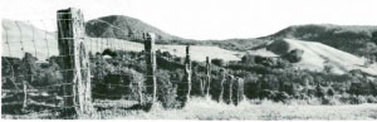
     The impact of the cattle can be seen today in the serpentine rock walls, built to keep out the early wild cattle, that weave through a timeless rugged terrain, marking early village sites, scattered throughou the Waimea plains mauka of Waiaka. 
    Young and strong, John Parker soon found himself riding a wave of change. When he arrived on the North Hawai'i Island, a seaman tired of travel, he embraced the people and lifestyle he found.  Like John Young and Isaac Davis he was befriended by King Kamehameha and eventually married King Kamehameha I’s granddaughter, Kipikane, settling on Waiapuka, his home in Kohala. However, Parker made many trips to the plains of Waimea, which was soon to become his home.
    Kamehameha having lifted the kapu on killing cattle Parker was often encountered hunting bullocks on the Waimea Plains and was renowned for his skill.  Traveling on foot, he tracked the wild cattle through
rugged terrain and forests. William Ellis, an English missionary, encountered Parker at his camp in Waimea where, “The beauty of the place was almost unnatural, enchanting.  Stretching above the reddish tinted water of a number of dancing streams the symmetrical, pyramid-like shapes of the Kohalas stood like the ruins of some forgotten civilization.” (Wellmon)  It was no wonder that Parker eventually moved his family to Waimea.
    But before Parker could establish his ranch in Waimea, another change had to take place.  The land tenure system, which was based on an ancient hierarchy of chiefs, did not permit private ownership of land.  Instead, favored chiefs were given a section of land called an ahupua’a, which usually ran in a pie shape from the mountains to the sea.  In turn, sections of that land were divided based on geographic features and granted to specific persons who were trained in the stewardship of those divisions and passed the knowledge on to the next generation. 
    However, these land grants were not absolute and could just as easily be reclaimed by the ruling chief and they were also exclusive with a few exceptions, of non-Hawaiians.  In 1839 the “Bill of Rights” was enacted that changed the monarchy to a constitutional one and created a Land Commission.  During this time, Parker established claim to the land near the foothills of Mauna Kea that he held with a lease agreement.  After petitioning the Land Commission, he was granted the 12 homestead acres that was soon to grow into a vast cattle operation known as Parker Ranch. 
    The next challenge was of the four legged variety. In order to have a cattle ranch, it is necessary to catch and corral the livestock.  After ten years, when the kapu was lifted by King Kamehameha, safely capturing the animals became the next problem. Bullock hunting using trained dogs and pits, was slow and sometimes dangerous work. The introduction of horses by Captain Richard J. Cleveland in 1803, provided the potential solution to this problem, although it was a few years still before horses were to be employed. 
     King Kamehameha III (Liholiho), realizing the value of using horses to manage cattle and also seeing the need for trained riders, invited the first cowboys, known as vaqueros, to Hawai'i Island.  These vaqueros, who arrived in 1832 from Mexico (now California) were skilled riders, cattle herders and leather workers, giving rise to the term paniolo.  “Hawaiians quickly adapted to the skills of the vaqueros.  In the summer of 1830, Liholiho and others of his court rode toward the southwest slope of Mauna Kea from Waimea village to climb the mountain.  One observer recalled that ‘the King appeared affable, kind and teachable on horseback,’ and successfully captured a young yearling bullock for lunch” (Wellmon).
    The skills of the vaqueros established formal cattle ranching in Waimea. “Horseman became a common sight.  Captured mountain cattle were domesticated.  Corrals and cattle pens were erected….These new ways became part of the heritage of the area, and in the following years Waimea emerged as an important cattle-raising frontier” (Wellmon)
Five Paniolos
    What follows are five short articles derived from interviews done by Waimea Middle School 7th and 8th graders through a grant project funded by Hawaii Community Foundation.  This project offered an opportunity for students to study local history, learn about doing oral history and to interview five paniolos and record their stories and hopefully gain some insight into the ranching life of Waimea. 
Picture
Teddy Bell 
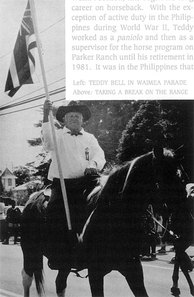
    Teddy Bell strode into Thelma Parker Library with the quiet self-assurance of someone who has seen it all and stayed on his horse.  Born in Waimea on August 14, 1923, Teddy Bell spent part of his childhood in Waiki’i where his father was a foreman for the Parker Ranch farming operation.  There was a small community in Waiki’i at that time, and from third grade on, Teddy attended a one-room school with about thirty students. 
     The day after finishing 8th grade, Teddy began working as a paniolo for Parker Ranch. “We got out of school, say June 9th; the 10th I was working already.  You feel beat when you start working.  Fifty cents a day.” Teddy started as a paniolo in the Waiki’i section; this began his long career on horseback.  With the exception of active duty in the Philipines during World War II, Teddy worked as a paniolo and then as a supervisor for the horse program on Parker Ranch until his retirement in 1981.
    It was in the Philipines that the fortitude, which came from his early paniolo experience served him well.  “At time of war, no one can tell me they are not afraid.  But you got a job to do and you have to do it.” The war ended on Teddy’s 22nd birthday, but he wasn’t celebrating.  “The first time they came in, you know, when Japan surrendered, it was August 14, 1945.  I can’t forget that day…It was a nasty day, but we were lucky.  We’re back home here today...”
    While finishing his time in the service on O’ahu, Teddy met his wife Pi’ilani.  When asked how he met her, a sparkle appeared in his eyes and with a chuckle he simply stated, “While I was in the service, and I met her in Honolulu—she’s from Hilo. That’s how we got acquainted.” As hard as we tried, we could not pry that story from him. 
    When he returned to Parker Ranch, Teddy began working with the horse program which he likened to building a car.  “You want to train a horse so he’s something like a car. You know the difference between a Jeep and a Cadillac—a Cadillac is something very comfortable.  A jeep is very uncomfortable.  That’s same like a horse.  You want a good, well-trained horse, it will be like a Cadillac.”
    After forty-plus years with Parker Ranch, Teddy Bell retired, but he hasn’t stopped working.  As well as doing a little cattle ranching himself, Teddy is inspired by his love of horses and his concern for the youth of our community, to volunteer his time teaching young kids to ride.
    Teddy Bell passed away on July 18, 2002 and was inducted into the Paniolo Hall of Fame posthumously later in 2002. 

Picture
Rally Greenwell
    Next time you are driving down Palani Road into Kona, think of Rally Greenwell;  that road was named after his father.  Born in Kona in 1914, Rally grew up with ranching.  Riding from the time he was three, he helped his father on the family ranch, also named Palani after his father Frank.  Rally is a tall, gracious man with a sense of humor that puts everyone in his presence at ease.
    Always preferring to be riding the range, Rally “didn’t like school, period.” But his parents had other ideas and he ended up completing twelve years of schooling, beginning with a one-room school in Kona. “In those days, there were few schools around and I went to a little, private school in Kona with ten or twelve children.  And the grades, there were probably three or four different grades.  So, you can see, it was just a small school.”
    At the age of eleven, Rally continued his education at a private school in the San Francisco area, and had the adventure of traveling with his two brothers on a Matson ship. “Once you got over the seasickness, it was a lot of fun.  They had different games that you would play and there would be quite a few other local kids on the boat that would be going back to school or something, so you would get to know them...”
    However, seasickness was not the only sickness he felt; Rally missed his home in the islands.  After completing his schooling at Roosevelt High School in Honolulu, Rally returned to his beloved Hawai'i Island and began working at Parker Ranch.
     He was with the ranch for ten years when his agricultural deferment expired and he was to be drafted into the service.  However, it was not to be.  “I took my physical and I was ready to go into the service and I left Parker Ranch.  I went home to Kona that night and somehow, Mr. Von Holt, who was manager and half owner of Kahua (ranch), heard about me leaving Parker Ranch, so he called me up and asked me if I wanted to come and work for him.  And I said, ‘Well, Mr. Von Hold, I’m sorry I’ve taken my physical, I’m going into the army.’ And he said, ‘I’m chairman of the draft board.  I can take care of that for you.’ Because switching from here going up there, I was changing jobs, going into agriculture again, so I could get another deferment.”
    It was at Kahua Ranch that Rally met his wife Pat, who was visiting from O’ahu.  Ever wonder how Buster Brown got its name? “She (Pat) lived in Honolulu and she was visiting her cousin, Buster Brown, who lived in Waimea here; they named this hill up here Buster Brown Hill.  The Marines named it Buster Brown Hill because he lived just below the hill there and they got to know him.”  Pat and Rally’s mutual love for riding led to a lifelong partnership. 
    After eight years with Kahua Ranch, Rally returned to Parker Ranch where he remained for nine years as manager until his retirement.  The paniolo life is the only life that Rally has known or wanted to know.  “Well, if I had to do my life all over again, I would do it exactly the same way.  I really have enjoyed my life.  It has been hard work but it has been a lot of fun.  I think it was quite different then what it is today.  We used to drive cattle for miles and miles….from here down to the pier at Kawaihae.”
    His only regret is that the paniolo today cannot experience the freedom of riding miles of range as he had the opportunity to do.  But actively rode the range in his own way; up until his passing a few years ago, you could see him in his signature broad-brimmed, white hat, driving around town in a vintage green Land Rover.
 
Rally passed away in June 2006 at the age of 92. 

Picture
Charlie Kimura
    Coming to the interview straight from work on a Friday afternoon, Charlie Kimura must have been ready for pau hana, but he still had the time and energy to share his story with us.  Born in Waimea in 1931, Charlie Kimura is the youngest of the interviewees.  He has spent most of his life in this community, with the exception of a stint in the Marines.  While he has had opportunities to leave, Charlie wanted to come back to Parker Ranch and the life he loved.
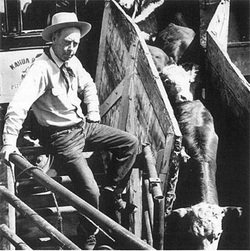
    He has worked as a paniolo, but also followed in his father Yutaka’s footsteps to work with the cattle breeding program.  “See, when I was a young boy before I went to school, my dad was foreman of the Holstein Dairy and they kept a lot of records.  You know, milk production.  I fell in love with that kind of stuff, so I stayed on.  And then as I grew up, you know, you like horses, but I got to learn.  My dad says, ‘It’s not a horse ranch, it’s a cattle ranch, so put your emphasis on cattle, not horses.’”
    Living with his family in the outer reaches of the Parker Ranch, Charlie loved everything about ranching. He began to ride when he was three and enjoyed a life populated with animals.  “We lived up in the mountain until I started school.  My older brothers and sisters came down and lived with my grandparents. But when I started school, we moved to Waimea…In those days when you live up the mountain, we didn’t see too many people.  When we came down to Waimea, when we went to school, we were like wild people and afraid of people.”
    Charlie attended both Waimea School and the Japanese School (located next to Church Row). “Then the war started in 1941, when I had just started fifth grade, and every thing stopped…The English school here, this Waimea School, was taken over by the hospital, and we had to go to school in private homes for a couple of years until they built a temporary school by the Episcopal Church.” 
    Although World War II brought upheaval to life in Waimea, it also brought unexpected pleasures such as rodeos. “There was one rodeo down here.  It was at Puihale and all the Marines were there.  And they didn’t build an arena, they just, the Marines were the arena!  They stacked them on the side and they let the animals out and the cowboys roped the cows or steers or whatever it was.  The marines just jumped on them and tackled them down, so they enjoyed themselves.  Parker Ranch put out a big barbecue and they had about twenty-five cattle to barbecue.  The Marines cooked the barbecue and everybody, we were just like family, we just walked right in there.  We used to go to outdoor movies in the Marine camps.”
    Beginning at the age of twelve, Charlie started to work for Parker Ranch in the summers milking cows.  After graduation from high school, Charlie began full-time work building fences, then moving up to paniolo.  Eventually, he became involved with the cattle breeding division of the ranch.  Although he didn’t attend college, Charlie continued to learn his craft.  “I went on learning.  I mean, practical schooling that I had on the ranch, but you don’t move up in position as fast as if you had some, had more education. So, I went to short courses of cattle schools to pick up all of these things. In 1960, I had a tutor for a month who showed me genetics because I was in charge of the register herd.”
    After being a livestock manager for seven years, Charlie became a division supervisor.  The ranching life, with its limitless variation continues to hold his fascination and admiration.  “When you work  with cattle, every day is different.” 
​Charlie passed away in 2019 at the age of 87.

Picture
John Lindsey
    John Lindsey exudes the kind of energy that defies his eighty-three years and left us chasing him down memory lane.  That life force has served him well throughout a varied career as ranch hand, paniolo and construction worker.
    Growing up, John found little opportunity for his energy to get him into much trouble though, because his grandfather was the local truant officer.  He rode a large, white horse and made it his business to know the location of every school age child in Waimea.  “Our time, the other boys who went to school, they never had time to fool around.  The truant officer would come in the morning and check out absentees.  He would check everyone.  There were two kids where Lakeland is.  One boy never showed.  He got there about 9:30 or 10:00.  Turned out he caught the boy playing in the yard, made him dress and the boy, from there, walked all the way to school.”
    John went directly from eighth grade to work for Parker Ranch.  “After I got out of the eighth grade, I ran from here to that office up there.  Parker Ranch office was there.  There was a post office, the Parker Ranch office, a store.  I walked into the office, the main man was there – Carter.  He looked at me and says, ‘What you want?’ … ‘Mr. Carter, I want a job.’  ‘You want to work or you want to play?’ I said, ‘Work.’ 'You start Monday.’ Just like that.  I mean work!”
    John wasn’t kidding. His early experiences were varied and served to prepare him for later career changes.  “I did everything.  I dug ditches, I laid pipeline, I did fencing and everything else.” One of those jobs involved working in the farming operation at Waiki’i.  “There were different seasons, like at Wiki’i we grew corn and all that…They grew hay, and in the season we got a crew there. It was a labor crew.  Then they cut the corn, mow the hay – not with new-fangled machines, with horse and sickle.  Then they raked it.”
    John began riding with the cowboy gang, moving cattle down to Kawaihae.  To protect them from the midday sun, they were taken part way down the hill on one day and then, beginning at around 1:00 a.m. the next, were driven the rest of the way to Kawaihae.  “That time we didn’t have roads, no nothing there.  But they had that big tree; they made a cattle road there and what you call a pasture.  In the meantime, there’s other cattle grazing in that area…On a moonlit night, it was like driving cattle during the day.  Beautiful, beautiful.”
    After 13 years with Parker Ranch, John set off to Honolulu where he worked in the Navy shipyard during the war and later in construction, both on O’ahu and Wake Island.  He eventually returned with his wife to Waimea where he now lives with his daughter, Helen and grandson, Shai-Anthony.  

John Lindsey passed away in 1998, not long after the completion of this project. 

Picture
Jiro Yamaguchi
    Jiro Yamaguchi’s shy demeanor belies his hard riding life.  After completing elementary school in 1938, “We started first grade, baby class.  At the end of the building was the seventh grade.  That’s when I quit school” and Jiro began his official career with Parker Ranch.  Although it was not his first experience working for them.  “Saturdays, Parker Ranch used to hire the Boy Scouts to work –  take like a test…take you out to the fields.  Work digging weeds, pulling grass, going up the pipeline, tape the pipelines.” 
    After a kind of apprenticeship as a general ranch hand, Jiro carried on from his father and began the job that was in his blood – paniolo. “Yeh, but you know to start most people, most employees start out slowly with mending the fence.  But like us, my family, most all of us could ride horses because by dad was a cowboy.  They used to put us on the horse all the time.  Summertime, I used to go with him early in the morning.”
    What is that saying?  The quickest road to a man’s heart is through his stomach.  This may have been the case here as Jiro met his wife, Asako, at the Parker Ranch Restaurant where she worked at the time.  Because it was wartime, and the church was being used by troops, Jiro and Asako were married in the home of the priest from the Imiola Church.  
    Another skill Jiro acquired from his day was roping.  “You have to learn because my dad was a pretty good roper.  So what I did was practice roping kids, roping friends, chasing wild pig and started that way.”  Jiro’s special skill with roping also got him in commercials that were seen in such far-flung places as Germany.  “We used to drive horses, drive cattle to make a commercial.  You have to rope the heifer and take it all on video for commercial.  Then I did one roping down at this corral down there – roping horse for a guy from UCLA.  Then the commercial went to Germany or someplace like that.”
    At first, because of a Parker Ranch rule against their paniolo participating  in rodeos, Jiro had to be satisfied honing his skill on the job.  Eventually, permission was granted and Jiro was off on his rodeo career.  When he retired in 1990, Jiro continued roping and sharing his skills with the youth of the community. 
Jiro passed away in July 2004.  
    All of these fine men have passed on but their contributions and stories will live on.  They were part of the living Aloha that makes Waimea a special place to live.  

2 Comments

Wa’a, Source of Ancient Wisdom, Sailing to the Future

5/15/2012

0 Comments


Wa’a, Source of Ancient Wisdom, Sailing to the Future

By Jan Wizinowich
PictureSouth Pacific voyaging canoes
    Hoku’lea’s 1976 voyage to Tahiti inspired a renaissance of Hawaiian Culture that continues to gather strength like a tsunami sweeping the Pacific.  The wa’a or canoe is at the center of that wave, a source of freedom, discovery and sustenance, forming a link to the  ancient wisdom born from a knowledge of and deep connection to the natural world. The whole process of building a canoe is a unifying one that connects the forest to the ocean and requires that people pull together.
    Finding the right tree, following the protocol for cutting and preparing it, working together to bring it on its first journey from forest to the ocean shore, the canoe emerges.  The canoe builder has ancient knowledge that allows him to enter into a dialogue with the spirit waiting within the log to take shape. The ‘ohana becomes attuned to that voice and is drawn into the anticipation of discovery, like waiting for the birth of a child. 
    The recent arrival of seven voyaging canoes from the South Pacific, (see: http://pvs.kcc.hawaii.edu), highlights this increasing reconnection with ancient knowledge and wisdom and a new solidarity between Pacific Islanders. This tremendous effort was made possible through many smaller efforts, just as the renaissance of Hawaiian Culture has come about through the efforts of many individuals joining their energies to perpetuate a path that will sustain future generations. 

PictureKimo and the HAAS canoe
    One such small, but significant effort at Hawaii Academy of Arts and Sciences (HAAS) in Pahoa, has reached completion this year.  Arriving at HAAS to meet Kimo Peleiholani-Blankenfeld , the canoe builder, we walk through the rain to the back of the school where the canoe rests under an open sided work area. Beyond, there is an expansive school garden, lush with food. Kimo and his wife, Mahealani arrive with big aloha smiles, offering a grounded, clear-eyed presence.
    The story of this canoe began in New Zealand, the point of origination of 8 rare New Zealand or Kauri pine seedlings planted at the state arboretum in Hilo and also the point of origin of one of the seven recently arrived voyaging canoes. The source of the log for the canoe is owed to the serendipitous aloha forces always at work here.  Just as characters can sometimes be in search of an author, a very special log was in search of a canoe builder.  
    “Three years ago just before I started this they had a storm and one of the trees fell over and they said it was termite eaten…. so they had this one guy cut all the trees down and the last one they cut down was this one, didn’t have termites.  And just so happened they had something for Obama, a rally in Hilo and Steve went, Hirakami he’s the head master of the Hawai'i Academy of Arts and Sciences (HAAS) charter school.  When he went he met the guy who cut em down, that’s his good friend. So they was talking and by the time they left there he told him that they had this log sitting over there and he told him that if he wanted they were going to donate it to the school and he called me the next day and he asked me if I wanted to work the canoe. I said, 'Sure!'” 
    Kimo’s canoe building life began on O’ahu, but was soon to take him all over the Pacific and the Hawaiian Islands. Kimo and his five siblings grew up in Honolulu, “Right there on the ocean in Kulio’o. So we always surfing, paddling canoe from 9 year-old, 10 year-old.”  His early experience with canoe building was with master builder, Wright Bowman.
​    “I knew Mr. Bowman from when I was 9 or 10. He was always a canoe builder from when I was a small kid.” Then at the age of 15 Kimo met his destiny when Puaniho Tauotaha entered his life.  “I learned to make canoes from my hanai father from Tahiti. From when I was 15 I started working. From then on I just chucked it all in and worked on canoes.” This began an odyssey throughout the Hawaiian Islands and Tahiti.  “From then on I traveled all around the Islands with him and Tahiti building canoes...He told me he built over three or four hundred canoes.”

Picture
   In the case of the HAAS canoe the log came to Kimo, but the building process usually  begins in the forest. “When looking in the forest for a canoe log, my father told me, ‘When you pick the canoe [log] in the forest and we’re standing up where the sun hits every day from the morning.'  In reality this side is like the hardest side already because it’s being baked everyday, everyday. He would make an X on the tree so when it fell down you would know exactly which side we going to use.” After the log is found and cut,“… we would work em up in the valley or wherever we found them in the mountains.  Carve em pretty much for a couple of days and then drag em out with the family, then trailer them home and work on em inside the canoe shed.”
    Ancient knowledge handed down through the generations was closely guarded. Kimo was the only person outside the ‘ohana to which Tauotaha passed on canoe building knowledge.  “He didn’t teach anybody outside of his family besides me for building canoes.  Lot of times we would be working and people would come around to see how he was doing stuff, he’d stop working and we’d just sit there and talk story until they left. Then we go back to work.”

PicturePuaniho, Tahitian waʽa building master
    In the Hawaiian Islands, Kimo and Puaniho built racing canoes for various island clubs. “Mostly we did all racing canoes in Hawaii. Kauai, Lanai, up on the Big Island, we did for Kaupua, Hui Nalu in Honolulu. We did canoes up for Kalapana. Then we went to Maui.  So pretty much all the islands we touched and went around.” 
    The project on Maui proved to be a bit more challenging. “The one in Maui was an old canoe John Lake built in the 30’s.  By the time we went over there in the 80’s it was in disrepair. Had only like the bottom part of the canoe.  Everything else was all rotten and we went and built it back up from scratch. It only looked like one feed trough when we started. From there we finished it just like this to the end and they’re racing it today for Maui for the Hawaiian Canoe Club.”
​    The challenge was patching together the sides and the bottom. “All glues, just glue. We got one patching machine. I swear one side had about 200 patches.  But when we finished was all good. The manu (the piece that covers the front and back of the canoe) for the canoe, the front and back manu comes from Kalapana, from the log we used to build the canoe for Kalapana. We brought em over there and we put em on. Was nice.”

PictureMahealani Peleiholani
    Kimo moved to Kalapana about 30 years ago when he was twenty and married into the Peleiholani family, whose residence in Kalapana traces back to the early 1800’s when Chief Peleiholani moved the ‘ohana from O’ahu.  Kimo and Mahealani have seven children, six girls and one boy and they are all involved with the canoe. “Everyone from baby all the way up work on the canoe.”
    Because the log was already in place, Kimo’s first task was to examine it to decide which side would be the bottom. After the bottom of the canoe is identified, a sort of sculpting process begins. “The first thing we did was the top. We cut off the top. And then we drew the lines for the sides. Then as soon as we got the lines for the side that was the second thing to come off. Once we got the sides off we tip it on the side and we did the bottom to get the shape we wanted.  We shaped the bottom with hand planers, electric planers.”

     There is a protocol for the order in which the work is done. “We do the outside first then we do the inside.  Because we got to finish the outside first cause if you take the inside, could make it too thin.  You got to get the whole shape done on the outside, then once you finish the whole shape you go in and jam the inside.”
​    This is done using a chain saw; several grooves are cut along the log and then an adze is used to finish carving it out. Getting the inside shaped right takes experience and is done, “Pretty much by feel…… So mostly, when we working on the inside, when we finished, usually we come down to one inch, maybe ¾ inch. Pretty much from tapping on the bottom of the hull you can see dust or whatever jumping on the inside.  I knew this thing would be light so I left if thick. Leaving it thick makes the boat more strong. I swear maybe two guys can lift it.”
Picture
    After the shaping, the manu are constructed and fitted on the canoe. Then the iako (the arms that reach out from the side) and the ama (the piece that is held by the iako) is attached. “The ama and the iako are made out of hao. Even in Tahiti the ama is made out of hao.” At various stages there is much sanding and finishing to be done, for which Kimo was assisted by HAAS students. “The group that was helping me was working the fish ponds in Kapoho and they working the fish ponds in Keaukaha. The days they weren’t traveling back and forth they were coming and helping me work on the canoe.”
    Kimo wanted the canoe to be one solid piece so he had to work with the dimensions of the log. It’s “not actually a racing canoe. It was short yeah.  Usually for a racing canoe it’s 45 feet long. This one is 32 feet [so] I only made it for 5 man.” That way the paddlers have room and will avoid hitting each other and there will be room for an extra paddle. Number 5 has room for seating and then they can put an extra steering paddle in back. Cause usually if the paddle breaks the steersman has an extra paddle in back or either that or he gonna take the one in front of him.  Somebody got to steer.  If they’re racing or doing long distance they got extra paddles one on each of the iako.”

Picture
    However it is possible to lengthen a canoe by setting another piece in the center, which is perhaps becoming more necessary with the dwindling supply of canoe logs of sufficient length. “One of the canoes we did [in Honolulu] we had to add on another 9 feet.  We took it to Mr. Bowman. He was the master canoe builder in Hawai'i.  We learned from him plenty.  We went to him and took the template from one of the canoes we built in Honolulu.  We took it up to his house and he figured out all the designs, all the cuts. He cut it out for us one night and we went in the morning and glued it all together. Next we went back, took the whole piece to the canoe we was working on. We set it right next to the canoe and it was exactly the same shape. The canoe is now at “...the Hui Nalu Canoe Club, that’s one of the fastest boats they got over there.”
    The name for the HAAS canoe, Hana Ka Naia (working dolphin), seemed to be a whisper from the canoe itself and the magic surrounding its creation.  “You just talk to the tutus and talk to the spirits.  I just asked my tutus and that name came to me. I went to talk to Steve and I said, ‘Hey Steve, when I finished the manu, I’m going to put the 'iwa birds on the back and on the front manu I’m going to put a couple dolphins.’ Every time you’re on the ocean in boats, dolphins are always in front and if you look in the sky you always got the 'iwa above.”
    The vital tradition of the canoe is being kept alive and growing throughout the Pacific, through the efforts of people like Kimo who give of themselves to the keiki, the ‘aina and the Akua, whose presence preserves and protects the culture that connects all the islands of the Pacific. “I’ve been doing other things for awhile but first was the canoes. I want to get back to the canoe.  I want to try and make a project and go to the schools and teach all the kids how to build them. If they want to learn our culture, that’s our culture, was based on the canoe. How we came to Hawaii was the canoe.  For our whole culture the canoe was the first.”  

0 Comments
<<Previous

    Archives

    January 2024
    December 2023
    September 2023
    August 2023
    January 2023
    November 2022
    August 2022
    March 2022
    January 2022
    May 2021
    April 2021
    March 2021
    January 2021
    September 2020
    June 2020
    March 2020
    November 2019
    October 2019
    September 2019
    July 2019
    May 2019
    March 2019
    January 2019
    November 2018
    September 2018
    August 2018
    July 2018
    June 2018
    March 2018
    February 2018
    September 2017
    August 2017
    June 2017
    March 2017
    February 2017
    January 2017
    November 2016
    October 2016
    August 2016
    June 2016
    December 2015
    October 2015
    September 2015
    August 2015
    April 2015
    February 2015
    December 2014
    November 2014
    October 2014
    September 2014
    July 2014
    May 2014
    December 2013
    October 2013
    September 2013
    August 2013
    December 2012
    November 2012
    September 2012
    June 2012
    May 2012

    Categories

    All
    2nd Division Marines
    2% Open Space Fund
    Adaptive Reuse
    Administration For Native Americans
    Adoption
    Aha Punanaleo
    A Hua He Inoa
    Ahu Akivi
    Ahualoa
    Ahupuaʻa
    Aina Based Education
    ʽĀinakea
    Ainamalu
    Ai Pono
    Akulikuli
    'Alae Cemetery
    Ala Kahakai National Historic Trail
    Ala Kahakai Trail
    Ala Kahakai Trail Association
    Alan Tokunaga
    Alapa'inui
    Albert Berdon
    Alenuihaha Channel Crossing
    Alethea Lai
    Ali'ikai Boats
    Alingano Maisu
    Al Jubitz
    Alo Kehau O Ka Aina Mauna
    Amanda Rieux
    Amaury Saint-Gilles
    Amida Buddha
    Anaehoomalu
    Anaehoʻomalu Bay
    Andy Anderson
    Angel Pilago
    Anghor Wat
    Animation
    Anna Akaka
    Anna's Pond
    Annexation
    Aric Arakaki
    Arioli
    Armstrong Yamamoto
    Art And History
    Art And Sol
    Artists
    Artists Cooperative
    Audrey S. Furukawa Scholarship
    Audrey Veloria
    Aumakua
    Auntie Genoa Keawe
    Aunty Agnes Aniu
    Aunty Betty Webster
    Aunty Lani Akau
    Aunty Maile
    Auwai
    Ava Fujimoto Strait
    AW Carter
    Baby Steps
    Barbara Haight
    Barbara Nobriga
    Barbara Robertson
    Barrie Rose
    Barry Rose
    Battery Storage
    Before The Flood
    Bennett Dorrance
    Bernice Berdon
    Bernice's Flower Shop
    Bernie Ohia
    Bertelmann
    Betty Jenkins
    Betty Meinardus
    Big Horn Medicine Wheel
    Big Island Giving Tree
    Bill Sproat
    Birth Stones
    BISAC
    Bishop Museum
    Blue Planet Energy Lab
    Blue Planet Research
    Bobbi Caputo
    Bob Juettner
    Bob Momson
    Bonaire
    Bon Dance
    Boys To Men
    Bryan Watai
    Bryce Groark
    Build A Better Brain
    Bullying
    Byakko Shinko Kai
    Byoung Yong Lee
    Canada France Hawaii Telescope
    Canoe
    Canoe Garden
    Caribbean
    Catalina Cain
    Catherine Morgan
    Cathy Lowder
    Cathy Morgan
    Cattle
    Chadd Paishon
    Chad Nakagawa
    Chair Yoga
    Charlene Iboshi
    Charlie Campbell
    Chelsey Dickson
    Cherry Blossom
    Cheung Family
    Chiefess Hoopiliahue
    Children's Advocacy Center
    Choy Hung Coon
    Chris Hawkins
    Christina Richardson
    Chu Daiko
    Ciro Podany
    C. Kalā Asing
    Clarence Mills
    Clay Bertelmann
    Clem Lam
    Cliff Johns
    Cody Dwight
    Cody Pueo Pata
    Collage
    Commission Of Water Resource
    Community Meal
    Congji Chon
    Connect For Success
    Conservation
    Cordage
    Counseling
    Craig McClain
    Croatia
    Dalani Tanahy
    Dana Moody
    Daniel Legler
    Danny Akaka
    Dave Allbee
    Dave Coon
    Dave Reisland
    David Gomes
    Deedee Bertelmann
    Dennis Chun
    Dennis Matsuda
    Department Of Hawaiian Homelands
    Descendents
    DHHL
    DHS
    Diane Kaneali'i
    Dickson
    DLNR
    Dolly Loo
    Donjihoe Investment Company
    Don Svendsen
    Dorrance Foundation
    Dot Uchima
    Doug Simons
    Dr. Isabella Abbott
    Dr. Ka'iu Kimura
    Dr. Larry Kimura
    Dr. Michael Graves
    Dr. Noenoe Silva
    Drug Rehabilitation
    Drug Treatment
    Dr. Wasan
    Dry Forest
    Dry Forest Conservation
    Dryland Forest
    Dryland Forest Hui 'Ohana
    Earl Bakken
    Earl's Garage
    Earl Veloria
    East Hawai'i Cultural Center
    Edith Kawai
    Edwin Lindsey
    `Ehuehu I Ka Pono
    Eileen Lum
    Eizuchi Higaki
    Elaine Flores
    Electrolyzer
    Elijah Rabang
    Elizabeth Lee
    Elizabeth Lindsey Kimura
    Elizabeth Woodhouse
    Elliot Parsons
    Elmer Lim
    Emalani Case
    E Mau Na Ala Hele
    Emily Weiss
    Energy
    English
    Environmental
    Environmental Education
    Environmental Monitoring And Control Center
    Eric Dodson
    Estria Foundation
    Estria Miyashiro
    Eunice Veincent
    Europe
    E. Woods Low
    Fair American
    Fairwind
    Falsetto
    Feather Lei
    Fern White
    Fig's
    Figueroa
    Firehouse Gallery
    Floria Shepard
    Flower Arranging
    Food Forest
    Four Seasons Resort
    Franz Solmssen
    Fred Cachola
    Friends Of Lili'uokalani Gardens
    Friends Of The Future
    Fr. Merrill
    Fuel Cells
    Gakuo Okabe
    Gary Chong
    Gary Eoff
    George Fry
    George Higaki
    George Hook
    Ginny Bivaletz
    Gino Amar
    Gourds
    Green Technology
    Gungbei
    Gwen Sanchez
    Gwen Yamamoto
    Gyo Mun Kim
    Hae Kyung
    Haia Auweloa
    Haku Lei
    Hale Kea
    Hale Kukui
    Hale Wa'a
    Hamakua
    Hamakua Bukkyo Kaido
    Hamakua Coffee
    Hamakua Jodo Mission
    Hanai Waa
    Hanauna Ola
    Harbin China
    Harold Craig
    Harry Buscher
    Harry Kim
    Hawaiian Ancestors
    Hawaiian Civic Club
    Hawaiian Cultural Practices
    Hawaiian Language
    Hawaiian Music
    Hawaiian Naming Practices
    Hawaiian Stilt
    Hawaiian Studies
    Hawaii Community Foundation
    Hawai'i Episcopal Academy
    Hawai'i Handweaver's Hui
    Hawaii Island Land Trust
    Hawai'i Island School Garden Network
    Hawai‘i Ponoʽī
    Hawai'i Preparatory Academy
    Hawai'i Public Seed Initiative
    Hawaii Sailing Canoe Association
    Hawaii State Art Museum
    Hawai'i State Mental Hospital
    Hawai'i Theater
    Hawi
    Hawi Christmas Lu'au
    Health And Wellness
    Health Maps
    Heather Sarsona
    HEEA
    Hee'ia
    He'eia Stream
    Helen Cassidy
    Helen Lincoln Lee Kwai
    Henk Rogers
    Herb Sigurdson
    High Chiefess Wao
    Highways Act Of 1892
    Hi‘iaka
    Hi'ilawe
    Hilo
    Hiroki Morinoue
    Hisao Kimura
    Hisashi Shimamura
    History
    Hohonu Journal
    Hokukano Ranch
    Hokulea
    Hokule'a
    Hokulea 2007 Voyage
    Hokuloa Church
    Hoku'ula
    Holistic Learning
    Holistic Teaching
    Holly Green
    Holly Sargent-Green
    Holomoana
    Homeless
    Honokaa
    Honokaa High School
    Howard Hall
    HPA
    Hualalai Cultural Center
    Hula
    Hulihe'e Palace
    Hydrogen Fuel
    Ieie Fiber
    Ihai
    'Ike Hawai'i
    Ike Hawaii
    Ili'ahi
    'Imiloa Astronomy Center
    Incheon Korea
    Indiana Jones
    Indigenous
    Inha Technical College
    Innovations Charter School
    Inoa Ho'omana'o
    Inoa Kūamuamu
    Inoa Pō
    Integrated Curriculum
    Ipo Kahele
    Isaac Davis
    IUCN
    Iwi
    Jack London
    Jade Bowman
    James Fay Kaaluea Kahalelaumamane
    James Kurokawa
    James Spencer
    James Taylor
    Jane Chao
    Janice Gail
    Japan
    Japanese Immigrants
    Japanese Maritime Students
    Jared Chapman
    Jay West
    Jean Boone
    Jen Lawson
    Jenny Cheesbro
    Jerry Bess
    Jesse Potter
    Jim Frasier
    Jim Jarret
    Joan Campbell
    Jodo Shu Mission
    Joel Tan
    Joe Sigurdsan
    Joe Souza
    Johanna Tilbury
    John Defries
    John Hoover
    Jordon Hollister
    Julian Fried
    Julie Williams
    Jun Balanga
    Ka`epaoka`āwela
    Ka Haka 'Ula O Ke'elikolani College Of Hawaiian Language
    Kahalu'u Bay Education Center
    Kahekili
    Kahiki
    Kahilu Theater
    Kahilu Theatre
    Kaho'olawe
    Kahua Ranch
    Kai Hawanawana
    Kaiholena
    Kai Kuleana
    Kailapa
    Kai Opua
    Ka'iu Kimura
    Ka'iulani Murphy
    Ka'iwakiloumoku
    Kalaemano
    Kalahuipua'a
    Kalaniana'ole Park
    Kalani Flores
    Kalani Schutte
    Kalaoa
    Ka Lei Maile Alii
    Kalepa Baybayan
    Kalo
    Kaloko-Honokōhau
    Kaluna Henrietta Ha'alo'u Kainapau
    Ka Makahiki Pule Aina Holo
    Kamakura
    Kamana Beamer
    Kamana'opono Crabbe
    Kamehameha
    Kamehameha Park
    Kamehameha Schools
    Kamehameha Statue
    Kamehameha V
    Kamiki
    Kamo`oalewa
    Kanaka'ole
    Kanak'ole
    Kanani Kaulu Kukui
    Kane
    Kane'ohe
    Kanile'a 'Ukulele
    Kani‘lehua
    Kanoa Castro
    Kano O Ka Aina
    Kanu O Ka Aina
    Kanu O Ka Aina Academy
    Kapa'au
    Kapakai
    Kapulei Flores
    Kapzphotography
    Karen Eoff
    Karin Hazelhoff
    Kar Tow
    Katie Benioni
    Katsu Goto
    Kauai
    Kaua'i Community College
    Kaua'i Kuhio Day Long Distance Race
    Kaʽūpūlehu
    Kawaihae
    Kawaihae Canoe Club
    Kawaihae I
    Kazuo Nakamura
    KCA
    Kea'au Kimchi Factory
    Keakealani
    Keala Kahuanui
    Kealakaʽi Knoche
    Kealakekua
    Kealakekua Bay
    Keali'i Bertelmann
    Keali'i Maielua
    Keanuiomano Stream
    Keaukaha
    Kehena Ditch
    Keiki Surf For The Earth
    Kekelaokalani
    Kekuhi Kanaka'ole Kanahele
    Keku'iapoiwa
    Ke Kumu Aina
    Kenneth Barthel
    Keokea
    Keokea Beach Park
    Keoki Freeland
    Keoki Manu
    Keomailani Case
    Keoni Kuoha
    Keoni Lindsey
    Keoua
    Kiho'alu
    Kiholo
    Kila
    Kilauea Plantation
    Kilo
    Kindy Sproat
    King Kamehameha
    Koa Canoe
    Koa'ekea
    Koa Forest
    Koaia
    Koaia Corridor
    Koaia Tree Sanctuary
    Koai'e Cove
    Kohakohau
    Kohala
    Kohala Center
    Kohala Coast
    Kohala Ditch
    Kohala Elementary
    Kohala High School
    Kohala Hospital
    Kohala Hospital Charitable Foundation
    Kohala Lihikai
    Kohala Middle School
    Kohala Mountain
    Kohala School
    Kohala Sugar
    Kohala Sugar Co.
    Kohala Village HUB
    Kohala Watershed
    Kohanaiki
    Kohanaiki Ohana
    Koh Ming Wei
    Kona
    Konea O Kukui
    Ko'o Heiau
    Korea History
    Korean Christian Institute
    Korean Natural Farming
    Koreans
    Krisin Souza
    Ku
    Ku Aina Pa
    Kue Petition
    Kūhiō
    Kuhio Village
    Ku Kahakalau
    Kukuihaele Landing
    Kukuku O Kalani
    Kulia Tolentino Potter
    Kulolo
    Kumukahi
    Kumu Kuwalu Anakalea
    Kumulipo
    Ku'ula
    Ku'ulei Keakealani
    Ku'ulei Kumai-Ho
    Kyoko Ikeda
    Lanakila Learning Center
    Lanakila Mangauil
    Lani Aliʽi
    Lanikepu
    Lanimaomao
    Lapakahi
    Laua'e Bertelmann
    Laulau
    Laupahoehoe Public Charter School
    Lawaia Manu
    Leandra Rouse
    Leesa Robertson
    Legacy Land Preservation Program
    Lehua Ah Sam
    Leila Kimura Staniec
    Lei Making
    Lei'ohu Santos-Colburn
    Leiola Mitchell
    Leo Mills
    Leonetta Mills
    Lester Kimura
    Lili'uokalani
    Lim Family
    Linda Kalawa
    Lindsey House
    Linus Chao
    Lio Lapaʻau
    Lisa Ferentinos
    Lisa Hadway
    Lithium Ion Phosphate Batteries
    Liz Moiha
    Lo'i
    Lokahi Giving Tree
    Lokahi Treatment Centers
    Long Ears Coffee
    Lono
    Lono Staff
    Lorenzo Lyons
    Lorraine Urbic
    Louisson Brothers
    Luakini
    Luana Zablan
    Lynn Taylor
    Mabel Beckley
    Mabel Tolentino
    Mahiki
    Mahiloe
    Mahina Patterson
    Mahukona
    Mai Piailug
    Makahiki
    Makahiki Moku O Keawe
    Makahiki Run
    Makaiole
    Makalii
    Makali'i
    Makali'i Bertelmann
    Makuakaumana
    Makuakuamana
    Mala'ai
    Mala'ai Culinary Garden
    Malaai Garden
    Malama Ahupuaa
    Malama Honua
    Mallchok
    Maly
    Māmalahoa
    Manny Veincent
    Mao`hau Hele
    Marcia Ray
    Margaret Hoy
    Margaret Waldron
    Mariechan Jackson
    Marie McDonald
    Marine Life Conservation District
    Marseille
    Mary Ann Lim
    Mary Kaala Fay
    Mary Kawena Pukui
    Mary Pukui
    Mary Sky
    Mary Sky Schoolcraft
    Masahisa Goi
    Master Han Kyu Cho
    Matt Hamabata
    Maud Woods
    Ma'ulili
    Ma'ulili Dickson
    Mauloa
    Mauna A Wakea
    Mauna Kea
    Mauna Kea Forest Restoration Project
    Mauna Lani
    Maunaua
    Mau Piailug
    Mealani Lum
    Meg Dehning
    Meisner Technique
    Mele Murals
    Melora Purell
    Mentoring
    Micah Komoaliʻi
    Michelle Suber
    Mid Pacific
    Mieko Fujimoto
    Mike Nelson
    Miloli'i
    Mindfulness Training
    Miriam Michaelson
    Mission Blue
    Mitch Roth
    Miyakaiku Carpenters
    Mo'ikena
    Mo'ikini Heiau
    Mokumanamana
    Moku Of Keawe
    Moku O Hawaii Canoe Racing Association
    Mokuola
    Mokuren
    Molly Sperry
    Moloka'i
    Momi Naughton
    Mo'okini Heiau
    Moon Soo Park
    Mormon Church
    Murals
    Music
    Nae'ole
    Nahaku Kalei
    Naha Stone
    Na Haumana La'au Lapa'au O Papa AuwaeAuw
    Na Kalai Waa
    Na Kalai Wa'a
    Nalei Kahakalau
    Namaste
    Nancy Botticelli
    Nancy Carr Smith
    Nancy Redfeather
    Nan Ga
    Nani Svendsen
    Nan Pi'ianaia
    Na 'Ohana Holo Moana
    Na Opio
    Na Pali Coast
    Napo'opo'o
    Na Pu'u
    Nate Hendricks
    National Parks Service
    Native Hawaiian Legal Corporation
    Nature Conservancy
    Navigation
    Nestorio Domingo
    New Zealand
    NHERC Heritage Center
    Nita Pilago
    Niuli'i
    Noe Noe Wong-Wilson
    Noni Kuhns
    Nonprofits
    Nora Rickards
    North Hawai'i
    North Kohala
    North Kohala Community Development Plan
    North Kohala Community Resource Center
    Obon
    Off Grid
    OHA
    Ohana
    Ohana Makalii
    'Ohana Wa'a
    Ohia Lehua
    Ohio State
    Ohohi Chadd Paishon
    Oiwi T.V.
    'Ola'a
    Ola Ka 'Aina
    Olana
    Oliver Lum
    'Onohi Chadd Paishon
    Opae Ula
    Opai
    Open World Delegation
    Oral History
    'Oumuamua
    Paauhau
    Pa'auhau
    Pacific Island Culture
    Pacific Studies
    Paddling
    Paishon
    Paka'alana
    Pakulea Gulch
    Palau
    Paleaku Peace Garden
    Palila
    Palmyra Atoll
    Pana'ewa Zoo
    Paniolo
    Papahana Kualoa
    Papahanaumokuakea
    Papa Henry Auwae
    Paradise Postal
    Park Bong Soong
    Parker Ranch
    Parker Ranch Center
    Parker School
    Parls Nails Hun
    Pat Hall
    Patrick Ching
    Patti Soloman
    Peace Poles
    Pele
    Pelekane
    Pelekane Bay
    Pelika Andrade
    Pete Erickson
    Pete Hackstedde
    Photovoltaic
    Pilina Kaula
    Pine Trees
    Pit River
    Plein Air Art
    Pohaha I Ka Lani
    Polani Kahakalau
    Pololu
    Polynesians
    Pomai
    Pomai Bertelmann
    Ponoholo Ranch
    Pono Von Holt
    Pōwehi
    Predators
    Prince Kuhio Kalanianiole
    Printing
    Protea
    Provisioning
    PTSD
    Pua Case
    Pua Kanaka'ole Kanahele
    Puako
    Puako: An Affectionate History
    Puako Community Association
    Puako Historical Society
    Puako Sugar Mill
    Pualani Kanahele
    Pualani Lincoln Maielua
    Pua Lincoln
    Public Art
    Pueo
    Pukui
    Puna
    Punahele
    Punahou
    Puna Kai Shopping Center
    Punana Leo O Waimea
    Punia
    Purell
    Puʻuhonua O Honaunau
    Pu'u Hulihuli
    Pu'ukohola Heiau
    Pu'u Pili
    Puʽuwaʽawaʽa
    Puʽuwaʽawaʽa Forest Bird Sanctuary
    Pu'u Wa'awa'a Ranch
    Pu'uwa'awa'a Ranch
    Qingdao China
    Queen Emma Land Co.
    Quilt
    Rain Gardens
    Rakuen
    Ranching Lifestyle
    Rangoon
    Raven Diaz
    Rebecca Most
    Rebecca Villegas
    Reef Teach
    Reforest Hawaii
    Reggie Lee
    Renewable Energy
    Requiem
    Resilient Hawaiian Community Initiati
    Reverend David Stout
    Rhonda Bell
    Richard Elliott
    Richard Pearson
    Richard Smart
    Ric Rocker
    Robbie Hines
    Roger Green
    Ronald Ibarra
    Rotary Club
    Royal Order Of Kamehameha I
    Run Off
    Ryon Rickard
    Ryoyu Yoshida
    Sacred Waters
    Sailing Canoes
    Salt Making
    Sam Huston State University
    Samuel Gruber
    Samuel Parker Jr.
    Sam Wilbur
    Sandlewood
    Sandy Takahashi
    San Francisco Call
    Sarah Kobayashi
    Savanack
    School Gardens
    Scot Plunkett
    Scott Kanda
    Scotty Grinsteiner
    Sea Of Hope
    Seri Luangphinith
    Shaelynne Monell-Lagaret
    Sharritt
    Shoichi Hino
    Shorty Bertelmann
    Silk Painting
    Sir Pua Ishibashi
    Ski Kwiatkowski
    Small World Preschool
    Solar
    Soloman
    Soloman Kapeliela
    Sony
    Sooty Tern
    Sophie Oki
    South Kohala Coastal Partnership
    Star Compass
    STARS Program
    STEM
    Stephanie Lindsey
    Steve Bess
    Steve Evans
    St. James Waimea
    Stonehenge
    Storks
    Student Art
    Sue Dela Cruz
    Sugarcane
    Sugar Plantation
    Susan Alexy
    Susan Maddox
    Susan Rickards
    Sustainable
    Sustain Generations
    Sweet Potato Cafe
    Sylvia-earl
    Syngman Rhee
    Taiko
    Taishoji Taiko
    Taiwan
    Tanikichi Fujitani
    Tatoo
    Tenugui
    Tesla
    The-nature-conservancy
    The Paths We Cross
    The-pod
    The-queens-women
    Thomas-metcalf
    Thomas Westin Lindsey
    Tiger Espere
    Tiger-esperi
    Tim Bostock
    Tim Hansen
    Tina Yohon
    Tom Hurley
    Tommy-remengesau
    Tommy-silva
    Tomoki Oku
    Tom-penny
    Tootsie Berdon
    Tora Mosai
    Travel
    Travels
    Trish Ryan
    Tropical-conservation-and-biology
    Tsugi-kaimana
    Tutu's House
    Tyler-paikulicampbell
    Tyrone Rheinhart
    U.H. Hilo
    UHH Mauna Kea Observatory
    Uhiuhi
    Uhi‘wai
    Uh-manoa
    Uh-west-oahu
    'ukulele Class
    Ulu-garmon
    Ulu-laau-nature-park
    Ululani Patterson
    Ulupalakua Ranch
    Umekichi Tanaka
    Uncle Mac Poepoe
    Uncle Walter Wong
    University-of-hawaii-sea-grant-college-program
    Verna-chartrand
    Vibrant Hawai'i
    Victoria-university
    Vincent-paul-ponthieux
    Vincent-paul-ponthieux
    Virginia-fortner
    Volcano Art Center
    Volcano Village
    Voyaging
    Voyaging Canoes
    Waa
    Waa7c86374d5e
    Waiaka
    Waianae-mountains
    Waiapuka
    Waihou
    Waikoloa
    Waikoloa-canoe-club
    Waikoloa-dry-forest-initiative
    Waikoloa-stream
    Wailoa Center
    Waimea
    Waimea Arts Council
    Waimea-christmas
    Waimea Civic Center
    Waimea Country School
    Waimea Educational Hui
    Waimea-hawaiian-civic-club
    Waimea Middle School
    Waimea-ocean-film-festival
    Waimea School
    Waimea Yoga
    Waipi699o
    Waipio
    Waipi'o Lookout
    Waipi'o Valley
    Waipio-valley-community-circle
    Waipunalei
    Waiulaula-stream
    Wao
    Wao Akua
    Wao Kanaka
    Wao Nahele
    Warren Noll
    Water
    Watercolor
    Watercolors
    Waterworld
    Wdfi
    Weaving
    Wendi Roehrig
    Wendy-hamane
    Wes Markum
    Whales
    Wh-rickard
    Wilds-brawner
    Wiliwili
    William Miller Seymour Lindsey
    Willy-mcglouthlin
    Women699s-work
    Women-artists
    World Peace Prayer Society
    World War II
    World-wide-voyage
    Yagura
    Ya Mul Kim
    Ymca
    Yokohama
    Yoshiko Ekuan
    Young Hi Lee
    Yutaka Kimura
    Ywca
    Zettelyss Amora


    RSS Feed

Powered by Create your own unique website with customizable templates.